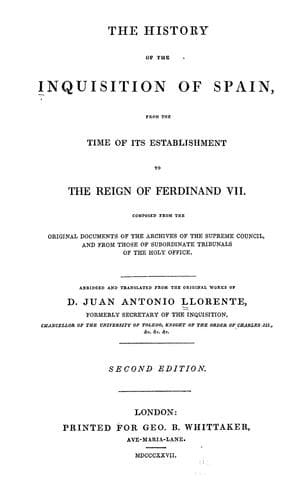
The History of the Inquisition of Spain from the Time of its Establishment to the Reign of Ferdinand VII.Llorente, Juan Antonio
History
The History of the Inquisition of Spain from the Time of its Establishment to the Reign of Ferdinand VII.
Llorente, Juan Antonio
Inquisition -- Spain
_Abad y la Sierra_ (Don Augustine), bishop of Barbastro. He was
denounced at Madrid in 1796 as a Jansenist, because he corresponded with
some of the French bishops who had taken the oaths. This denunciation
had no result. He was attacked a second time at Saragossa in 1801. His
accusers renewed the charge of correspondence with the French bishops,
and his having granted matrimonial dispensations according to a royal
order was imputed to him as a crime. This accusation failed as well as
the former.
_Abad y la Sierra_ (Don Manuel), archbishop of Selimbria _in partibus
infidelium_, inquisitor-general after Don Augustine Rubin de Cevallos.
In 1794 Charles IV. commanded him to quit his office, and to retire to
Sopetran, a Benedictine monastery near Madrid. Don Manuel was possessed
of great talents and profound learning; his opinions were enlightened in
the highest degree. In 1793 this prelate commanded me to make him a plan
for an establishment of learned qualifiers to censure books and persons.
After being informed of the principles of my system, he commissioned me
to write a work to expose the vices of the procedure of the holy office,
and to propose one more useful to religion and the state. When this
prelate lost his office of inquisitor-general, he was denounced as a
Jansenist by a fanatical monk, but the information was neglected.
_Arrellano_ (Don Joseph Xavier Rodriguez d'), archbishop of Burgos, and
a member of the council extraordinary of Charles III. This prelate has
composed a great number of works on the theological principles of the
_Summary of St. Thomas_, which are taught by the Dominicans, and are in
opposition to the moral of the Jesuits. The partisans of the Jesuits,
and some friends of the Inquisition, denounced Arellano as a Jansenist,
because he expressed opinions favourable to temporal power, and defended
the royal and civil authorities against the holy office. The inquisitors
could not take any advantage of the denunciation, because it did not
express any particular proposition.
_Buruaga_ (Don Thomas Saenz de). He was archbishop of Saragossa, and
incurred the same danger as Arellano.
_Muzquiz_ (Don Raphaël de), born at Viana in Navarre. He was almoner and
preacher to Charles III. and Charles IV., confessor of the Queen Louisa,
successively bishop of Avila and archbishop of Santiago. He was
implicated in the affairs of Don Antonio de la Cuesta and his brother,
and this was sufficient to induce the inquisitors to prosecute him. This
prelate was one of the persecutors of the two brothers. Charles IV.,
having ordered the writings of the trial to be submitted to him,
discovered the intrigue, and condemned the archbishop to pay a
considerable fine, and receive a reprimand.
Public-domain text, read in full here on John Shaqi.
Reviews
Reviews
No reviews yet
Be the first to share your thoughts on this work.
Elsewhere in the archive
Join the Discussion
Join the discussion
Sign in to leave a comment or review.
Sign InorCreate an account