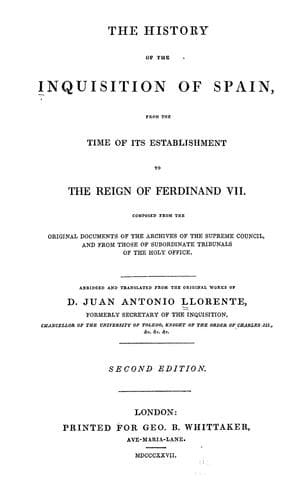
The History of the Inquisition of Spain from the Time of its Establishment to the Reign of Ferdinand VII.Llorente, Juan Antonio
History
The History of the Inquisition of Spain from the Time of its Establishment to the Reign of Ferdinand VII.
Llorente, Juan Antonio
Inquisition -- Spain
_Acuña_ (Don Antonio), bishop of Zamora, commander of one of the armies
of Castile, which were raised by the people for the war of the _Commons_
against the oppression of the Flemings, who governed Spain in the name
of Charles V. That prince wished that the bishop and the priests who
engaged in the war, as soldiers, should be punished by the Inquisition
as suspected of heresy, because they acted in opposition to the spirit
of peace taught by Jesus Christ and his Apostles, and contrary to the
spirit of the Catholic Church. Leo X., however, pretended that it would
be a scandal if the bishop was punished by the holy office; and that it
would be sufficient if he was judged at Rome, and the priests by their
diocesan prelates.
_La Plana-Castillon_ (Don Joseph de), bishop of Tarragona. He was a
member of the council-extraordinary convoked by Charles III. The
inquisitors noted him as a Jansenist for the same reasons as
_Arellano_.
_Mendoza_ (Don Alvarez de), bishop of Avila. He was noted in the
registers of the Inquisition as suspected of heresy, from the
declarations of some of the witnesses in the trial of Carranza.
CHAPTER XXX.
OF THE PROSECUTION OF SEVERAL SAINTS AND HOLY PERSONS BY THE
INQUISITION.
An account has been already given of the persecutions of Don Ferdinand
de Talavera, first Archbishop of Granada; of Juan Davila, surnamed the
Apostle of Andalusia; and of San Juan de Dios, founder of the
congregation of Hospitallers. The following is a list of other holy
persons who have been prosecuted by the holy office:--
St. Ignacius de Loyola was denounced as an _illuminati_ to the
Inquisition of Valladolid; and when the inquisitors were about to arrest
him, he went to France, afterwards to Italy, and arrived at Rome, where
he was tried and acquitted; after having been so likewise in Spain by a
juridical sentence of the vicar-general of the Bishop of Salamanca. His
real name was Iñigo.
Melchior Cano says, in an unpublished work written during the life of
Iñigo, "that he fled from Spain when the Inquisition intended to arrest
him as a heretic of the sect of _Illuminati_. He went to Rome, and
wished to be judged by the Pope. As no person appeared to accuse him, he
was discharged."
It is certain that St. Ignacius was arrested at Salamanca in 1527, as a
_fanatic_ and _illuminati_, and that he recovered his liberty in about
twenty-two days; he was enjoined in his preaching from qualifying mortal
or venial sins, until he had studied theology four years. It is also
true that when the inquisitors of Valladolid learnt that the saint was
in prison, they wrote to cause an inquest to be made of the words and
actions which caused a suspicion that he was one of the _Illuminati_.
Public-domain text, read in full here on John Shaqi.
Reviews
Reviews
No reviews yet
Be the first to share your thoughts on this work.
Elsewhere in the archive
Join the Discussion
Join the discussion
Sign in to leave a comment or review.
Sign InorCreate an account