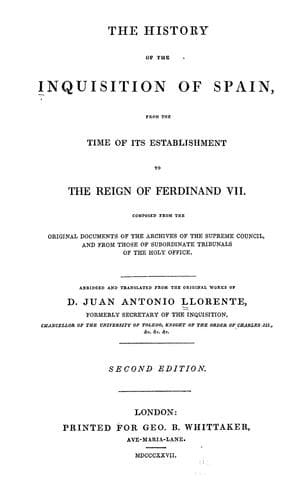
The History of the Inquisition of Spain from the Time of its Establishment to the Reign of Ferdinand VII.Llorente, Juan Antonio
History
The History of the Inquisition of Spain from the Time of its Establishment to the Reign of Ferdinand VII.
Llorente, Juan Antonio
Inquisition -- Spain
But it is not proved that Ignacius quitted Spain to escape from
punishment; it appears that he only fulfilled his intention of studying
theology at Paris. The humility of the saint was so great, that when he
was denounced a second time in that city, to Matthew d'Ory the
apostolical inquisitor, he surrendered himself voluntarily, and had no
difficulty in proving his orthodoxy.
It is not more certain that he went to Rome at that time, since he was
still at Paris in 1535, and he afterwards returned to Spain, where he
remained a year without being molested, though he preached in several
provinces. He then embarked for Italy, went first to Bologna, and then
to Venice, where he was a third time denounced as a heretic, but
justified himself to the papal nuncio, and was admitted into the
priesthood in that city. Ignacius arrived in Rome in 1538.
It cannot be proved that he was acquitted at Rome because he had no
accuser, since any criminal may be prosecuted by the minister of the
public and punished. It is true that there was not at that time a
particular tribunal of the Inquisition at Rome; but the civil judges
could punish heretics, and the procurator-fiscal impeached the
criminals. St. Ignacius was again denounced by a Spaniard named Navarro.
The informer deposed that Ignacius had been accused and convicted of
several heresies in Spain, France, and Venice, and charged him with some
other crimes. Fortunately his three judges knew his innocence, and he
was acquitted. His accuser was banished for life, and three Spaniards
who had supported his evidence were condemned to retract.
Thus it appears that Melchior Cano was misinformed when he wrote, ten
years after, that Iñigo was acquitted because no accuser appeared.
St. Francis de Borgia, a disciple of Loyola, and third general of his
order, succeeded Lainez, in 1565, and died 1572. He had been the Duke de
Gandia, and was cousin to the king in the third degree, by his mother,
Jane of Arragon.
In 1559, the Inquisition of Valladolid tried several Lutherans, who were
condemned. Many of these heretics, who endeavoured to justify themselves
by supporting their doctrine by the opinions of St. Francis de Borgia,
whose virtue was well known, related some discourses and actions of this
saint, to prove that they thought as he did on the justification of
souls by faith, on the passion and death of Jesus Christ; and added, to
strengthen their defence, the authority of some mystic treatises. Among
these involuntary persecutors, was Fray Dominic de Roxas, his near
relation, and advantage was taken of a former denunciation of his
_Treatise on Christian Works_, which he composed while he was known as
the Duke of Gandia.
Public-domain text, read in full here on John Shaqi.
Reviews
Reviews
No reviews yet
Be the first to share your thoughts on this work.
Elsewhere in the archive
Join the Discussion
Join the discussion
Sign in to leave a comment or review.
Sign InorCreate an account