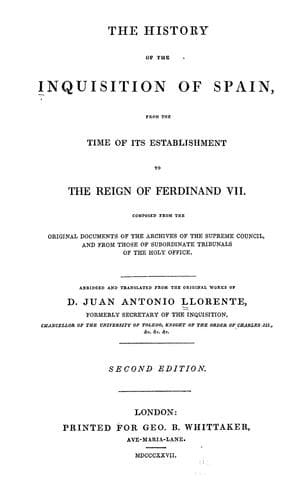
The History of the Inquisition of Spain from the Time of its Establishment to the Reign of Ferdinand VII.Llorente, Juan Antonio
History
The History of the Inquisition of Spain from the Time of its Establishment to the Reign of Ferdinand VII.
Llorente, Juan Antonio
Inquisition -- Spain
Garcia Alvarez Osorio soon procured a sufficient sum of money at
Seville, and Don Carlos prepared to commence his journey towards the
middle of January, 1568. He requested his uncle, Don John, to accompany
him according to a promise he had made when informed of his design. Don
Carlos made many promises to his uncle, who replied that he was ready to
do whatever he thought proper, but that he feared the journey could not
take place, on account of the danger they would incur. Don John informed
the king, who was at the Escurial, of this circumstance; Philip
consulted several theologians and jurisconsults to ascertain if he could
conscientiously continue to feign ignorance, in order to cause his son
to perform his journey. Martin d'Alpizcueta (so celebrated under the
title of the Doctor Navarro) was one of the persons consulted; he
advised the king not to allow Don Carlos to depart, urging that it was
the duty of a sovereign to avoid civil wars, which were likely to be the
result of such a journey, as the loyal subjects of Flanders might go to
war with the rebels. Cabrera says that Melchior Cano was likewise
consulted in this affair[45], but Fray Melchior died in 1560.
The prince communicated his intentions to Fray Diego de Chaves, who
endeavoured to dissuade him, but without success. Don Carlos went to
make a visit to the wife of Don Diego de Cordova, the king's master of
the horse. This lady discovered, from some expressions which dropped
from Don Carlos, that he was prepared to depart, and immediately
informed her husband, who was at the Escurial with the king, and who
gave the letter to his majesty. At last, on the 17th January, 1568, Don
Carlos sent an order to Don Ramon de Tasis, director-general of the
posts, to have eight horses ready for him on the following night. Tasis,
fearing that this order covered some mystery, and knowing the prince's
character, replied that all the post-horses were engaged, and gained
sufficient time to inform the king. Don Carlos sent a more peremptory
order, and Tasis, who dreaded his violence, sent all the post-horses out
of Madrid, and repaired to the Escurial. The king went to the Pardo (a
castle about two leagues from Madrid), where Don John joined him. Don
Carlos, who was ignorant of his father's removal, wished to have a
conference with his uncle, and went as far as _Retamar_[46], whence he
sent for him to come to him. The prince recounted all the arrangements
for his journey. Don John replied that he was ready to set out with him,
but as soon as he left him, he returned to the king to tell him all that
he had heard. The king immediately went to Madrid, where he arrived a
few minutes after Don Carlos[47].
The arrival of the king altered the measures of Don Carlos, and
prevented him from insisting upon having horses that night. Louis
Cabrera has given some details of the circumstances of his arrest, but I
prefer inserting the account of the affair, which was written by the
usher a few days after.
Public-domain text, read in full here on John Shaqi.
Reviews
Reviews
No reviews yet
Be the first to share your thoughts on this work.
Elsewhere in the archive
Join the Discussion
Join the discussion
Sign in to leave a comment or review.
Sign InorCreate an account