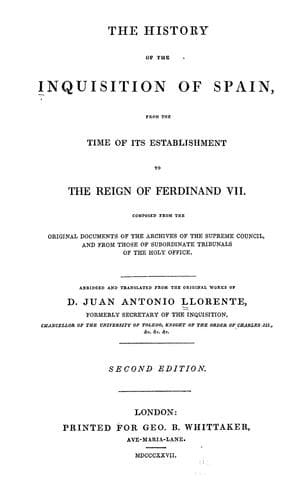
The History of the Inquisition of Spain from the Time of its Establishment to the Reign of Ferdinand VII.Llorente, Juan Antonio
History
The History of the Inquisition of Spain from the Time of its Establishment to the Reign of Ferdinand VII.
Llorente, Juan Antonio
Inquisition -- Spain
"The prince, my master," says he, "had been for some days unable to
take a moment's rest; he was continually repeating that he wished to
kill a man whom he hated. He informed Don John of Austria of his design,
but concealed the name of the person. The king went to the Escurial, and
sent for Don John. The subject of their conversation is not known; it
was supposed to be concerning the prince's sinister designs. Don John,
doubtless, revealed all he knew. The king soon after sent post for the
Doctor Velasco; he spoke to him of his plans, and the works at the
Escurial, gave his orders, and added that he should not return
immediately. At this time happened the day of jubilee, which the court
was in the habit of gaining at Christmas; the prince went on the
Saturday evening to the Convent of St. Jerome[48]. I was in attendance
about his person. His royal highness confessed at the convent, but could
not obtain absolution, on account of his evil intentions. He applied to
another confessor, who also refused. The prince said to him, '_Decide
more quickly_.' The monk replied, '_Let your highness cause this case to
be discussed by learned men_.' It was eight o'clock in the evening; the
prince sent his carriage for the theologians of the convent of
_Atocha_[49]. Fourteen came, two and two; he sent us to Madrid to fetch
the monks Albarado, one an Augustine, the other a Maturin; he disputed
with them all, and obstinately persisted in desiring to be absolved,
always repeating that he hated a man until he had killed him. All these
monks declaring that it was impossible to comply with the prince's
request, he then wished that they should give him an unconsecrated
wafer, that the court might believe that he had fulfilled the same
duties as the rest of the royal family. This proposal threw the monks
into the greatest consternation. Many other delicate points were
discussed in this conference, which I am not permitted to repeat.
Everything went wrong; the prior of the Convent of _Atocha_ took the
prince aside, and endeavoured to learn the quality of the person he
wished to kill. He replied that he was a man of very high rank, and said
no more. At last the prior deceived him, saying, '_My Lord, tell me what
man it is; it may, perhaps, be possible to give you absolution according
to the degree of satisfaction your highness wishes to take._' The prince
then declared that it was the king, his father, whom he hated, and that
he would have his life. The prior then said, calmly, '_Does your
highness intend to kill the king yourself, or to employ some person to
do it?_' The prince persisted so firmly in his resolution, that he could
not obtain absolution, and lost the jubilee. This scene lasted until two
hours after midnight; all the monks retired overwhelmed with sorrow,
particularly the prince's confessor. The next day I accompanied the
prince on his return to the palace, and information was sent to the king
of all that had passed.
Public-domain text, read in full here on John Shaqi.
Reviews
Reviews
No reviews yet
Be the first to share your thoughts on this work.
Elsewhere in the archive
Join the Discussion
Join the discussion
Sign in to leave a comment or review.
Sign InorCreate an account