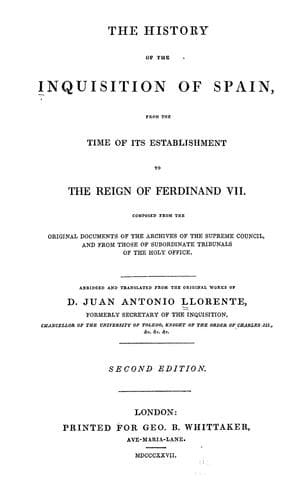
The History of the Inquisition of Spain from the Time of its Establishment to the Reign of Ferdinand VII.Llorente, Juan Antonio
History
The History of the Inquisition of Spain from the Time of its Establishment to the Reign of Ferdinand VII.
Llorente, Juan Antonio
Inquisition -- Spain
was decided on, because neither the time nor place permitted it.
"The king retired; the duke took the keys of the doors, and sent away
the valets and other servants of the prince. He placed guards in the
cabinet, four _Monteros d'Espinosa_, four Spanish halberdiers, and four
Germans with their lieutenant. He afterwards came to the door where I
was, and placed there four _Monteros_, and four guards, and told me to
retire. The keys of the prince's escrutoires and trunks were then taken
to the king; the beds of the valets were taken away. The Duke de Feria,
the Count de Lerma, and Don Rodrigo, watched by his highness that night;
he was afterwards watched by two chamberlains, who were relieved every
six hours. The persons appointed by the king for this service, were the
Duke de Feria, the Prince of Evoli, the prior, Don Antonio de Toledo,
Louis Quijada, the Count de Lerma, Don Fadrique Enriquez, and Don Juan
de Valesco[56]; they did not wear arms for this service. The guards did
not allow us to approach either night or day. Two chamberlains prepared
the table; the major-domo came to fetch the dinner in the court. No
knives were allowed, the meat was taken in already cut up. Mass was not
said in the prince's apartment, and he has not heard it since he was
imprisoned[57].
"On Monday[58] the king assembled in his apartment all the councillors
and their presidents; he made to each council a report of the arrest of
his son; he said that it had taken place for things which concerned the
service of God and the kingdom. Eye-witnesses have assured me that his
majesty shed tears in making this recital. On Tuesday, his majesty
convoked in his apartment the members of the Council of State; they
remained there from one o'clock till nine in the evening. It is not
known what they were occupied with. The king made an inquest; Hoyos was
the secretary[59]. The king was present at the declarations of each
witness; they were written down, and formed a pile six inches in height.
He gave to the council the privileges of the _Majorats_[60], as well as
those of the king and prince of Castile, that they might take cognizance
of them.
"The queen and the princess were in tears[61]. Don Juan went to the
palace every evening; he went once plainly dressed and in mourning; the
king reproached him, and told him to dress himself as usual. On the
Monday above-mentioned his majesty gave orders that all the prince's
valets-de-chambre should retire to their respective homes, promising to
provide for them. He caused Don Fadrique, the admiral's brother, and the
prince's major-domo, and Don Juan de Valesco to enter into the service
of the queen." _Here finishes the relation of the usher._
Public-domain text, read in full here on John Shaqi.
Reviews
Reviews
No reviews yet
Be the first to share your thoughts on this work.
Elsewhere in the archive
Join the Discussion
Join the discussion
Sign in to leave a comment or review.
Sign InorCreate an account