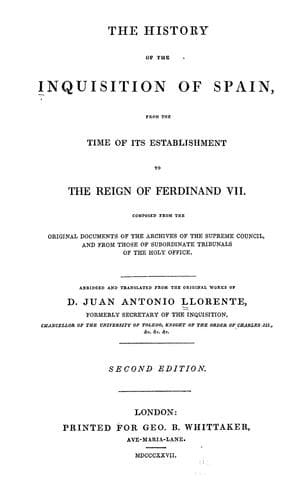
The History of the Inquisition of Spain from the Time of its Establishment to the Reign of Ferdinand VII.Llorente, Juan Antonio
History
The History of the Inquisition of Spain from the Time of its Establishment to the Reign of Ferdinand VII.
Llorente, Juan Antonio
Inquisition -- Spain
"Sacred, Catholic, and Royal Majesty:--The municipality of Murcia has
received your majesty's letter containing your determination relating to
the imprisonment of our prince. The municipality kisses your majesty's
feet a thousand times for the distinguished favour shown them in
informing them of this event; it is fully persuaded that the reasons and
motives which have guided your majesty were so important, and so
conducive to the public good, that you could not do otherwise. Your
majesty has governed your kingdom so well, maintained your subjects in
such a state of peace, and caused religion to prosper so much, that it
is natural to conclude, that in an affair which concerns you so nearly,
your majesty has only resolved on it for the service of God, and the
general welfare of your people. Nevertheless, this city cannot help
experiencing unfeigned sorrow, for the important causes which have given
fresh grief to your majesty; it cannot consider without emotion, that it
possesses a sovereign sufficiently just and attached to the good of his
kingdom to prefer it before everything, and to make him forget his
tender affection for his own son. So great a proof of love must compel
your majesty's subjects to testify their gratitude by their submission
and fidelity. This city, which has always been distinguished for its
zeal, will, at this time, give a greater proof of it in immediately
obeying your majesty's commands. God preserve the royal and Catholic
person of your majesty! In the municipal council of Murcia, February
16th, 1568."
Pius V., and all the other persons to whom Philip had written, replied,
by interceding for his son. They said it might be hoped that so striking
an event would be a check to the prince, and induce him to alter his
conduct. No one made more earnest intercessions than Maximilian II.; it
is true that he was more interested on account of the marriage intended
for his daughter. He was not satisfied with writing, but sent the
Archduke Charles to Madrid, for the purpose of interfering. The journey
which the archduke was obliged to make into Flanders and France, was the
ostensible motive for that to Madrid. Philip was inflexible; he not only
detained the prince as a prisoner, but proved, by the following
ordinance, that he intended to keep him so. It was confirmed by the
Secretary Pedro del Hoyo, and the execution of it confided to the Prince
of Evoli, who was appointed his lieutenant-general in everything
relating to the prince. It was as follows:--
Public-domain text, read in full here on John Shaqi.
Reviews
Reviews
No reviews yet
Be the first to share your thoughts on this work.
Elsewhere in the archive
Join the Discussion
Join the discussion
Sign in to leave a comment or review.
Sign InorCreate an account