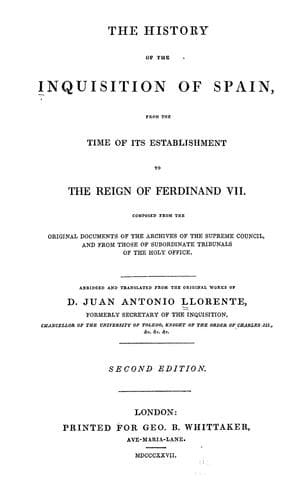
The History of the Inquisition of Spain from the Time of its Establishment to the Reign of Ferdinand VII.Llorente, Juan Antonio
History
The History of the Inquisition of Spain from the Time of its Establishment to the Reign of Ferdinand VII.
Llorente, Juan Antonio
Inquisition -- Spain
The preliminary case, drawn by Don Diego Bribiesca de Muñatones, was
sufficiently advanced in the month of July, to allow of a final
sentence, without examining the criminal, or to appoint a procurator for
the king, who in quality of fiscal accused the prince of the crimes
stated in the _preparatory instruction_. No judicial notice was sent to
the prince; they had only the declarations of the witnesses, letters,
and other papers.
These writings proved that, according to the laws of the kingdom, Don
Carlos must be condemned to death, for high treason, on two counts:
first, for having attempted parricide; and secondly, for having framed a
plan to usurp the sovereignty of Flanders, by means of a civil war.
Muñatones made a report of this, and the punishments established for
such crimes, to the king; he added, that particular circumstances, and
the rank of the criminal, might authorize his majesty to declare, that
general laws could not affect the eldest sons of kings, because they
were subject to laws of a higher nature, those which related to policy,
and the welfare of the state; lastly, that the monarch might, for the
good of his subjects, commute the punishment.
Cardinal Espinosa and the Prince of Evoli were of the opinion of
Muñatones; Philip then said, that his heart inclined him to follow their
advice, but that his conscience would not permit him to do so: that he
thought it would be far from being a benefit to Spain; that, on the
contrary, he thought it would be the greatest misfortune that could
happen to his kingdom, to be governed by a king devoid of knowledge,
talents, judgment, or virtue, full of vices and passions, and, above
all, furious, ferocious and sanguinary; that these considerations
compelled him, notwithstanding his attachment to his son, and his
anguish at so terrible a sacrifice, to suffer the laws to take their
course; but considering that the health of Don Carlos was in such a
state that there was no hope of prolonging his life, he thought it would
be better to suffer him to satisfy himself in his inclinations in eating
and drinking, since, from the disorder of his ideas, he would not fail
to commit some excess, which would lead him to the tomb: that the only
thing which concerned him, was the necessity of persuading his son that
his death was inevitable, and that in consequence he must confess
himself to ensure salvation; that this was the greatest proof of
affection which he could show to his son and the Spanish nation.
Public-domain text, read in full here on John Shaqi.
Reviews
Reviews
No reviews yet
Be the first to share your thoughts on this work.
Elsewhere in the archive
Join the Discussion
Join the discussion
Sign in to leave a comment or review.
Sign InorCreate an account