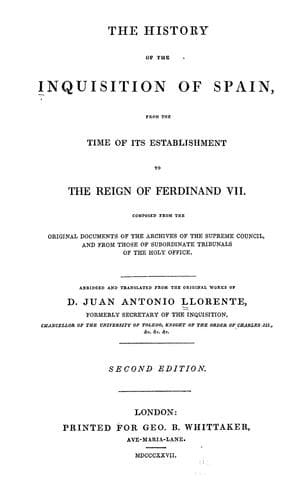
The History of the Inquisition of Spain from the Time of its Establishment to the Reign of Ferdinand VII.Llorente, Juan Antonio
History
The History of the Inquisition of Spain from the Time of its Establishment to the Reign of Ferdinand VII.
Llorente, Juan Antonio
Inquisition -- Spain
This decision of the king is not mentioned in the writings of the trial.
There was no sentence written or signed; but the secretary Hoyo, in a
note, says, _that at this period of the trial the prince died of his
malady, and this was the reason why no sentence was pronounced_. The
proof of the fact exists in other papers, in which the curious anecdotes
of the time have been related. Although these documents are not
authentic, they merit attention, as they were written by persons
employed in the king's palace, and accord with what some writers have
insinuated. It is true that they did think proper not to speak plainly
on such delicate subjects, but they have said enough to lead to the
truth.
Cardinal Espinosa and the Prince of Evoli thought that they should
fulfil the intentions of Philip in hastening the death of Don Carlos;
they agreed that the physician should inform the prince of his
condition, without saying anything of the king's displeasure or of the
trial, and that he should prepare him to receive the exhortations which
would be made for the benefit of his soul: by these means they hoped to
induce him to confess and prepare himself for death, which would put an
end to his misfortunes.
The Prince of Evoli held a conference with the Doctor Olivares. He spoke
to him in that mysterious and important manner which persons versed in
the politics of courts know so well how to employ, when it is necessary
to further the views of their sovereign, or their own designs. Rui Gomez
de Sylva was perfect in this art, according to the opinion of his friend
Antonio Perez, the first secretary of state, who was well acquainted
with all that passed. In one of his letters he says, _that after the
death of the Prince of Evoli, there would be no one but himself
initiated in these mysteries_.
Olivares perfectly understood that he was expected to execute the
sentence of death pronounced by the king; and that it was to be done in
such a manner, that the prince's honour should not be affected; in
short, that his death was to appear natural. He therefore endeavoured to
express himself, so as to inform the prince of Evoli that he
comprehended him, and considered it as an order from the king.
On the 20th of July, Olivares ordered a medicine which Don Carlos took.
Louis Cabrera, who was employed in the palace at that time, and who
often saw Rui Gomez, says in his history of Philip II., that "_this
medicine did not produce any beneficial effect; and the malady appearing
to be mortal_, the physician informed the patient, that he must prepare
to die like a good Christian, and receive the sacraments."
Public-domain text, read in full here on John Shaqi.
Reviews
Reviews
No reviews yet
Be the first to share your thoughts on this work.
Elsewhere in the archive
Join the Discussion
Join the discussion
Sign in to leave a comment or review.
Sign InorCreate an account