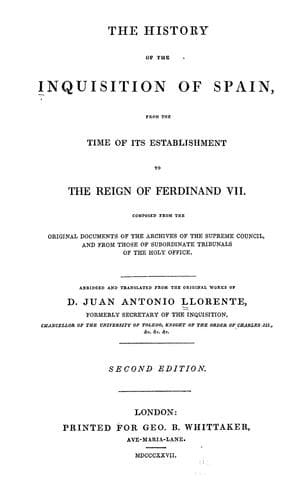
The History of the Inquisition of Spain from the Time of its Establishment to the Reign of Ferdinand VII.Llorente, Juan Antonio
History
The History of the Inquisition of Spain from the Time of its Establishment to the Reign of Ferdinand VII.
Llorente, Juan Antonio
Inquisition -- Spain
In 1477, Philip de Barbaris, inquisitor of the kingdom of Sicily, went
to Seville, to obtain from Ferdinand and Isabella the confirmation of a
privilege granted in 1233, by the Emperor Frederic, which gave to the
Inquisition of Sicily the right of seizing a third part of the property
of condemned heretics. Barbaris, through zeal for the interests of the
Pope, endeavoured to persuade the king that the Christian religion
derived the greatest advantages from the fear which the judgments of the
Inquisition inspired. He was eagerly seconded by Alphonso de Hojida,
prior of the convent of Dominicans at Seville; and Nicholas Franco, the
nuncio of the Pope at the court of Spain. A report was then spread in
different parts of the kingdom that the _New Christians_, with the
unbaptized Jews, insulted the images of Jesus Christ, and had even
crucified Christian children in mockery of his sufferings on the cross.
Ferdinand was willing to receive the Inquisition into his states: the
only obstacle was the refusal of Isabella; that excellent queen could
not approve of measures so contrary to the gentleness of her character,
but her consent was obtained by alarming her conscience: she was told
that it became a religious duty to adopt them in the present
circumstances.
Isabella suffered herself to be led away by the representations of her
council, and commissioned her ambassador at Rome, Don Francis de
Santillan, Bishop of Osma, to solicit in her name a bull for the
establishment of the Inquisition in Castile, which was granted in 1478.
It authorized Ferdinand and Isabella to name the priests who were to be
commissioned to discover in their states all heretics, apostates, and
favourers of these crimes. As this measure was displeasing to Isabella,
her council, by her order, suspended the execution of the bull until
less severe remedies had been tried.
The queen commissioned D. Diego Alphonso de Solis, Bishop of Cadiz,
Diego de Merlo, and Alphonso de Hojida, prior of the convent of
Dominicans, to observe the effects produced by gentle means, and give a
faithful account of them. Their reports were such as might be expected
from the situation of affairs; and the Dominican fathers, the nuncio,
and even the king, desired that the measures preferred by Isabella
should be declared insufficient.
Public-domain text, read in full here on John Shaqi.
Reviews
Reviews
No reviews yet
Be the first to share your thoughts on this work.
Join the Discussion
Join the discussion
Sign in to leave a comment or review.
Sign InorCreate an account