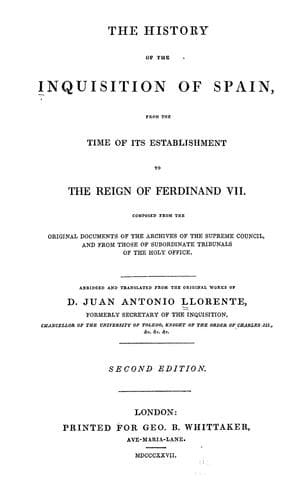
The History of the Inquisition of Spain from the Time of its Establishment to the Reign of Ferdinand VII.Llorente, Juan Antonio
History
The History of the Inquisition of Spain from the Time of its Establishment to the Reign of Ferdinand VII.
Llorente, Juan Antonio
Inquisition -- Spain
One of the most illustrious victims of the holy office was Don
Bartholomew Carranza de Miranda, Archbishop of Toledo. The writings of
the trial amount to twenty-four folio volumes, each containing one
thousand or twelve hundred pages. This immense mass of writings must
doubtless contain many facts unknown to Don Pedro Salazar de Mendoza,
the author of the life of Carranza. This respectable writer spared no
expense to discover the truth, but could not penetrate the mystery which
envelopes the proceedings of the Inquisition. I have read this trial,
which enables me to fill up the omissions of Salazar de Mendoza, and
correct his involuntary errors.
Bartholomew Carranza was born in 1503, at _Miranda de Arga_, a little
borough in the kingdom of Navarre: he was the son of Pedro Carranza, and
grandson of Bartholomew, both members of the nobility of Miranda. His
true family name, consequently, was _Carranza_; but while he was a
Dominican monk, he was only called Miranda. When he was made Archbishop
of Toledo, he was named Carranza de Miranda, to prove the identity: he,
however, only signed the name Fray Bartholomeus Toletanus, according to
the custom of the times. The family of Carranza has been perpetuated to
the eighteenth century, in the direct male line from Pedro, brother to
the archbishop. At twelve years of age, Bartholomew, through the
interest of his uncle Sancho de Carranza, a doctor in the university of
Alcala de Henares, and the antagonist of Erasmus, was received into the
College of St. Eugenius, which was dependant on the university. When he
attained his fifteenth year, he passed into the College of St. Balbina,
to study what was then called _philosophy and the arts_, which was
confined to some general ideas of logic, metaphysics, and physics. In
1520 he took the habit of a Dominican, in the Convent of _Venaleç_, in
the _Alcarria_, which was afterwards transferred to the city of
_Guadalaxara_. As soon as he had professed, he was sent to study
theology in the College of St. Stephen of Salamanca and in 1525 he was
placed in that of St. Gregory of Valladolid.
Public-domain text, read in full here on John Shaqi.
Reviews
Reviews
No reviews yet
Be the first to share your thoughts on this work.
Elsewhere in the archive
Join the Discussion
Join the discussion
Sign in to leave a comment or review.
Sign InorCreate an account