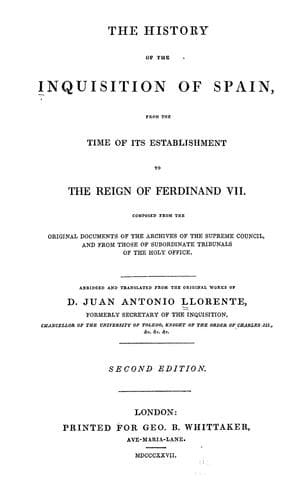
The History of the Inquisition of Spain from the Time of its Establishment to the Reign of Ferdinand VII.Llorente, Juan Antonio
History
The History of the Inquisition of Spain from the Time of its Establishment to the Reign of Ferdinand VII.
Llorente, Juan Antonio
Inquisition -- Spain
Thomas de Torquemada, first inquisitor-general of Spain, died the 16th
of November, 1498. The miseries which were the consequences of the
system which he adopted, and recommended to his successors, justify the
general hatred which followed him to the tomb, and compelled him to take
precautions for his personal safety. Ferdinand and Isabella permitted
him to use an escort of fifty _familiars_ of the Inquisition on
horseback, and two hundred others on foot, whenever he travelled. He
also kept the horn of a unicorn on his table, which was supposed to
discover and neutralize poisons. It is not surprising that many should
have conspired against his life, when his cruel administration is
considered: the Pope himself was alarmed at his barbarity, and the
complaints which were made against him; and Torquemada was obliged to
send his colleague, Antonio Badoja, three times to Rome, to defend him
against the accusations of his enemies.
At last Alexander VI., weary of the continual clamours of which he was
the object, resolved to deprive him of his dignity, but was deterred
from so doing through consideration for the Court of Spain. He therefore
expedited a brief in 1494, saying, that as Torquemada had arrived at a
great age, and suffered from many infirmities, he had named four
inquisitors-general, invested with the same powers which he possessed.
The familiars of the holy office, who were employed as the body-guard of
the inquisitor-general, were the successors of the familiars of the Old
Inquisition. They were commissioned to pursue the heretics, and persons
suspected of heresy, to assist the officers of the tribunal in taking
them to prison, and to do all that the inquisitors might require.
It has been shown that the Spaniards received the Inquisition with
reluctance; but as they were obliged to endure it when once established,
some prudent persons thought they should be more secure from the danger
of incurring suspicion, if they appeared devoted to the cause, which was
the reason why several illustrious gentlemen offered to become
_familiars of the holy office_, and were admitted into the congregation
of St. Peter. Their example was followed by the inferior classes, and
encouraged by Ferdinand and Isabella, who bestowed several immunities
and privileges on them.
CHAPTER IX.
OF THE PROCEDURE OF THE MODERN INQUISITION.
Public-domain text, read in full here on John Shaqi.
Reviews
Reviews
No reviews yet
Be the first to share your thoughts on this work.
Elsewhere in the archive
Join the Discussion
Join the discussion
Sign in to leave a comment or review.
Sign InorCreate an account