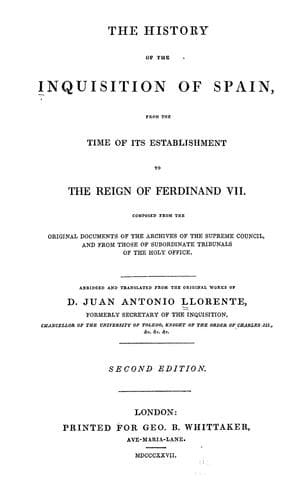
The History of the Inquisition of Spain from the Time of its Establishment to the Reign of Ferdinand VII.Llorente, Juan Antonio
History
The History of the Inquisition of Spain from the Time of its Establishment to the Reign of Ferdinand VII.
Llorente, Juan Antonio
Inquisition -- Spain
After the death of the Inquisitor-general, Torquemada, Ferdinand and
Isabella proposed Don Diego Deza, a Dominican, to the Pope, as his
successor. Deza was Bishop of Jaen, and afterwards became Archbishop of
Seville. The Pope signed his bulls of confirmation on the 1st of
December, 1498, but limited his authority to the affairs of the kingdom
of Castile. Deza was displeased at a restriction which did not exist in
the bulls of his two colleagues, and refused to accept the nomination,
until the Pope invested him with the same power over Aragon, in a bull,
in 1499. The new inquisitor-general did not show less severity in the
exercise of his office than his predecessor; but, before I enter on this
part of the history, it is necessary to give some account of the mode of
proceeding of the holy office, as it was the work of Torquemada, the
effect of the laws which he formed, and properly belongs to his
history.
The processes in the Inquisition began by a denunciation, or some other
information, such as a discovery accidentally made before the tribunal
in another trial. When the denunciation is signed, it takes the form of
a declaration, in which the informer, after having sworn to the truth of
his deposition, designates those persons whom he presumes, or believes,
to have anything to depose against the accused person. These persons are
then heard, and their depositions, with that of the first witness, form
the _summary of the information, or the preparatory instruction_.
_Inquest._
When the tribunal judged that the actions or words which were denounced
were sufficient to warrant an inquiry to establish the proofs, the
persons who had been cited as knowing the object of the declaration were
examined, and were obliged to take an oath not to reveal the questions
which were put to them. None of the witnesses were informed of the
subject on which they were to make their depositions; they were only
asked in general terms, _if they had ever seen or heard anything which
was, or appeared, contrary to the Catholic faith, or the rights of the
Inquisition_.
Personal experience has shown me that the witnesses who were ignorant of
the cause of their citation often recollected circumstances entirely
foreign to the subject, which they made known, and were then
interrogated as if their examination had no other object; this
accidental deposition served instead of a denunciation, and a new
process was commenced.
The declarations were written down by the commissary or notary, who
usually aggravated the denunciation, as much as the arbitrary
interpretation of the improper or equivocal expressions used by ignorant
persons would permit. The declaration was twice read to the witnesses,
_who did not fail to approve all that had been written_.
_Censure of the Qualifiers._
Public-domain text, read in full here on John Shaqi.
Reviews
Reviews
No reviews yet
Be the first to share your thoughts on this work.
Elsewhere in the archive
Join the Discussion
Join the discussion
Sign in to leave a comment or review.
Sign InorCreate an account