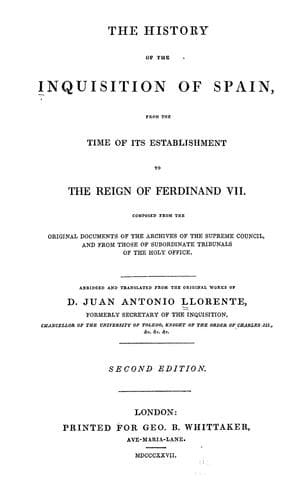
The History of the Inquisition of Spain from the Time of its Establishment to the Reign of Ferdinand VII.Llorente, Juan Antonio
History
The History of the Inquisition of Spain from the Time of its Establishment to the Reign of Ferdinand VII.
Llorente, Juan Antonio
Inquisition -- Spain
When the inquisitors examine the preliminary _instruction_, if they find
sufficient cause to proceed, they send a circular to all the tribunals
in the province to inquire if any charges against the accused exist in
their registers. This proceeding is called the _review of the
registers_. Extracts are made of the propositions against the accused,
and if each is expressed in different terms, which is almost always the
case, they are sent as accusations advanced on different occasions. This
writing was then remitted to the theologians, _qualifiers of the holy
office_, who write at the bottom of the page if the propositions merit
the _theological censure_, as heretical, if they give occasion to
suppose that the person who pronounced them approved of any heresy, or
if he is only suspected of that crime.
The declaration of the _qualifiers_ determines the proceedings against
the accused, until the trial is prepared for the definite sentence. The
_qualifiers_ were generally scholastic monks, almost entirely
unacquainted with true dogmatic theology, and who carried fanaticism and
superstition to such a height as to find heresy in everything which they
had not studied: this disposition has often caused them to censure some
of the doctrines of the fathers of the church.
_Prisons._
When the qualification has been made, the procurator-fiscal demands that
the denounced person shall be removed to the _secret prisons_ of the
_holy office_. The tribunal has three sorts of prisons, public,
intermediate, and secret. The first are those where persons are
imprisoned, who are not guilty of heresy, but of some crime which the
Inquisition has the privilege of punishing: the second are destined for
those servants of the holy office who have committed some crime in the
exercise of their functions, without incurring suspicion of heresy.
Those who are detained in these prisons are permitted to communicate
with others, unless they are condemned to solitary confinement. The
secret prisons are those where all heretics, or persons suspected of
heresy, are confined; they can only communicate with the judges of the
tribunal.
These prisons are not, as they have been represented, damp, dirty, and
unhealthy; they are vaulted chambers, well lighted, not damp, and large
enough for a person to take some exercise in. The real horrors of the
prisons are, that no one can enter them without becoming infamous in
public opinion; and the solitude and the darkness to which the prisoner
is condemned for fifteen hours in the day during the winter, as he is
not allowed light before the hour of seven in the morning, or after four
in the evening. Some authors have stated, that the prisoners were
chained; these means are only employed on extraordinary occasions, and
to prevent them from destroying themselves.
_First Audiences._
Public-domain text, read in full here on John Shaqi.
Reviews
Reviews
No reviews yet
Be the first to share your thoughts on this work.
Elsewhere in the archive
Join the Discussion
Join the discussion
Sign in to leave a comment or review.
Sign InorCreate an account