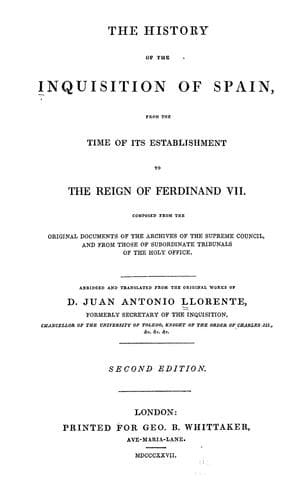
The History of the Inquisition of Spain from the Time of its Establishment to the Reign of Ferdinand VII.Llorente, Juan Antonio
History
The History of the Inquisition of Spain from the Time of its Establishment to the Reign of Ferdinand VII.
Llorente, Juan Antonio
Inquisition -- Spain
In the three first days following the imprisonment of the culprit, he
had three _audiences_ of _monition_, or caution, recommending him to
speak the truth, without concealing anything that he had done or said,
or that he can impute to others, contrary to the faith. He was told that
if he followed this recommendation he would be treated leniently; but in
the contrary case, he would be proceeded against with severity. Until
then the prisoner is ignorant of the cause of his arrest; he is only
told that no person is taken to the prison of the holy office without
sufficient proof that he has spoken against the Catholic faith, and,
therefore, it is for his interest to confess his crimes voluntarily.
Some prisoners confessed themselves guilty of the crimes stated in the
preparatory instruction; others acknowledged more; others less;
generally the prisoners declared that their consciences did not reproach
them, but that they would endeavour to recollect the faults which they
had committed if the accusations of the witnesses were read to them.
The advantages of the confession were, that it lessened the duration of
the trial, and rendered the punishments inflicted on the accused less
severe when the reconciliation took place. Whatever promises might be
made to the prisoners, they could not avoid the disgrace of the
_san-benito_ and _auto-da-fé_, or preserve their honour or their
property, if they acknowledged themselves _formal_ heretics.
Another custom of the Inquisition was to examine the prisoner on his
genealogy and parentage, in order to discover by the registers of the
tribunal if any of his family had been punished for heresy, supposing
that he might have inherited the erroneous doctrines of his ancestors.
He was also obliged to recite the _Pater_, the _Credo_, and other forms
of Christian doctrine, because the presumption that he had erred in his
faith was stronger, if he did not know them, had forgotten them, or if
he made mistakes in the repetition. In short, the Inquisition employed
every means, and neglected nothing in the trial of the prisoners, to
make them appear guilty of heresy, and all this was done with an
appearance of charity and compassion, and in the name of Jesus Christ.
_Charges._
Public-domain text, read in full here on John Shaqi.
Reviews
Reviews
No reviews yet
Be the first to share your thoughts on this work.
Elsewhere in the archive
Join the Discussion
Join the discussion
Sign in to leave a comment or review.
Sign InorCreate an account