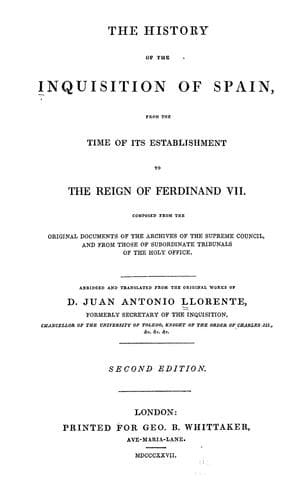
The History of the Inquisition of Spain from the Time of its Establishment to the Reign of Ferdinand VII.Llorente, Juan Antonio
History
The History of the Inquisition of Spain from the Time of its Establishment to the Reign of Ferdinand VII.
Llorente, Juan Antonio
Inquisition -- Spain
When the ceremony of the three first audiences is finished, the
procurator-fiscal forms his act of accusation against the prisoner, from
the preliminary instruction. Although a semi-proof only exists, he
reports the facts in the depositions as if they were proved; and what
is still more illegal, he does not reduce the articles of his
_requisition_ to the number of facts, but following the practice in
forming the extracts of the propositions for the act of _qualification_,
he multiplies them according to the variations in the statements; so
that an accusation which ought to be reduced to one point, contains five
or six charges, which appear to indicate that the accused has advanced
so many heretical opinions on different occasions, without any
foundation but the different manner in which each witness relates the
conversation.
This mode of proceeding produces the worst effects; it confuses the
prisoner where the charges are read to him, and if he has not coolness
and intelligence, he imagines that several crimes are imputed to him,
and replies, for instance, to the third article, and relates the facts
in different words from those which he employed in answering the second;
this variation taking place in each article, he sometimes contradicts
himself, and thus furnishes the fiscal with fresh accusations against
him, for he is accused of not adhering to truth in his replies.
_Torture._
Although the prisoner has confessed all that the witnesses deposed
against him in the first audiences, yet the fiscal terminates his
_requisition_ by saying, that he is guilty of concealment and denial,
that he is, therefore, impenitent and obstinate, and demands that the
question shall be applied to the accused.
It is true, that it is so long since torture has been inflicted by the
inquisitors, that the custom may be looked upon as abolished, and the
fiscal only makes the demand in conformity to the example of his
predecessors, yet it is equally cruel to make the prisoners fear it.
In former times, if the inquisitors judged that the prisoner had not
made a full confession, they ordered him to be tortured: the object was
to make him confess all that formed the substance of the process. I
shall not describe the different modes of torture employed by the
Inquisition, as it has been already done by many historians: I shall
only say that none of them can be accused of exaggeration. When the
accused acknowledged the crimes imputed to them, during the torture,
they were obliged the next day to ratify or retract their confession
upon oath. Almost all confirmed their first statement, because they were
subjected to the torture a second time if they dared to retract.
_Requisition._
Public-domain text, read in full here on John Shaqi.
Reviews
Reviews
No reviews yet
Be the first to share your thoughts on this work.
Elsewhere in the archive
Join the Discussion
Join the discussion
Sign in to leave a comment or review.
Sign InorCreate an account