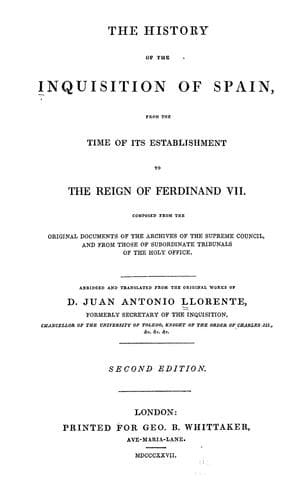
The History of the Inquisition of Spain from the Time of its Establishment to the Reign of Ferdinand VII.Llorente, Juan Antonio
History
The History of the Inquisition of Spain from the Time of its Establishment to the Reign of Ferdinand VII.
Llorente, Juan Antonio
Inquisition -- Spain
The requisition or accusation of the procurator-fiscal was never given
to the prisoner in writing, that he might not reflect on the charges in
prison and prepare his replies. The prisoner is conducted to the
audience-chamber, where a secretary reads the charges, in the presence
of the inquisitors and the fiscal: between each article he calls upon
the prisoner to reply to it instantly, and declare if it is true or
false.
It is evident that this proceeding is intended to embarrass the
prisoner, by compelling him to reply without previous reflection. Such
stratagems are allowed in other tribunals where the prisoners are guilty
of homicide, theft, or other offences against society; but it must be
allowed that it is against the spirit of Christianity to employ them
where zeal for religion and the salvation of others seem to be the
motives for acting.
_Defence._
When the charges and the _accusation_ have been read, the inquisitors
ask the prisoner if he wishes to make a defence; if he replies in the
affirmative, a copy of the _accusation_ and the replies is taken. He is
then required to select the lawyer whom he wishes to employ for his
defence, from the list of those belonging to the holy office. Some
prisoners required permission to seek a defender out of the tribunal, a
pretension which is not contrary to any law, particularly if the lawyer
has taken an oath of secrecy; yet this simple and natural right has
seldom been granted by the inquisitors.
It is of little consequence to the accused to be defended by an able
man, as the lawyer is not allowed to see the original process, or to
communicate with his client. One of the notaries draws up a copy of the
result of the _preliminary instruction_, in which he reports the
deposition of the witnesses, without mentioning their names, or the
circumstances of time or place, and (what is more extraordinary) without
stating what has been said in defence of the prisoner. He entirely omits
the declarations of the persons who, having been summoned and
interrogated by the tribunal, have persisted in affirming that they knew
nothing of the subject on which they were examined. This extract is
accompanied by the censure of the _qualifiers_, and the demand of the
fiscal for the examination, and the accusation, and the replies of the
accused. This is all that is given to the defender in the
audience-chamber, where the inquisitors have commanded him to attend. He
is then obliged to promise to defend the prisoner if he thinks that it
is just to do so; but, in the contrary case, that he will use all the
means in his power to persuade him to solicit his pardon of the
tribunal, by a sincere confession of his sins, and a demand to be
reconciled to the church.
Public-domain text, read in full here on John Shaqi.
Reviews
Reviews
No reviews yet
Be the first to share your thoughts on this work.
Elsewhere in the archive
Join the Discussion
Join the discussion
Sign in to leave a comment or review.
Sign InorCreate an account