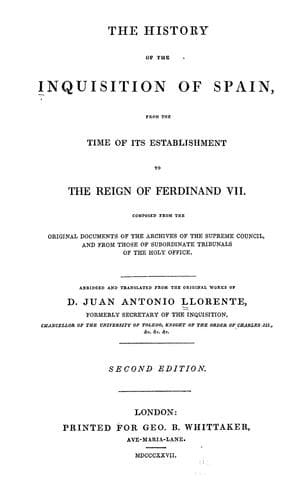
The History of the Inquisition of Spain from the Time of its Establishment to the Reign of Ferdinand VII.Llorente, Juan Antonio
History
The History of the Inquisition of Spain from the Time of its Establishment to the Reign of Ferdinand VII.
Llorente, Juan Antonio
Inquisition -- Spain
Those who have acquired any experience in criminal proceedings, are
aware of the great advantages which may be derived from the comparison
of the testimony of the witnesses in the defence of the accused; but the
direction given to the proceedings by the Inquisition is such, that the
lawyer can rarely find any means of defence but that which arises from
the difference and variations in the depositions on the actions and
words imputed to the prisoner.
As this is not sufficient, (because the semi-proof exists,) the defender
generally demands to see the prisoner, that he may inquire if it is his
intention to challenge the witnesses, to destroy, either in part, or
entirely, the proof established against him. If he replies in the
affirmative, the inquisitors order proceedings to prove the irregularity
of the witnesses.
_Proof._
It is then necessary to separate all the original declarations of the
witnesses from the process, and send them to the places which they
inhabit to receive a _ratification_. This takes place without the
knowledge of the prisoner, and as he is not represented by any person
during this formality, it is impossible that the challenge of a witness
should succeed, even if he was the greatest enemy of the prisoner. If
the witness was at Madrid at the time of the instruction, and afterwards
went to the Philippine Isles, the course of the trial was suspended, and
the prisoner was obliged to wait till the ratification arrived from
Asia. If he demanded an audience, to complain of the delay, he was
answered with ambiguity, that the tribunal could not proceed with
greater haste, as it was occupied with particular measures.
The prisoner made his challenge of the witnesses by naming those whom he
considered as his enemies, giving his reasons for mistrusting them, and
writing on the margin of each article the names of those persons who
could attest the facts which are the causes of the challenge. The
inquisitors decree that they shall be examined, unless some motive
prevents it.
As the prisoner is not acquainted with the proceedings, he often accuses
persons who have not been summoned as witnesses. The article in which
they are mentioned is passed over with those of the witnesses who have
not deposed against him, or who have spoken in his favour. Thus he
encounters his accusers only by chance.
It sometimes happens that the procurator-fiscal secretly obtains the
proof of the morality of the witnesses, in order to destroy the effect
of the challenge; and as this is more easy to accomplish than the
measures taken by the prisoner, they are generally rendered useless,
because in doubtful cases the inquisitors are always disposed to depend
upon the witness, if he is not known to be the declared enemy of the
accused.
_Publication of the Proofs._
Public-domain text, read in full here on John Shaqi.
Reviews
Reviews
No reviews yet
Be the first to share your thoughts on this work.
Elsewhere in the archive
Join the Discussion
Join the discussion
Sign in to leave a comment or review.
Sign InorCreate an account