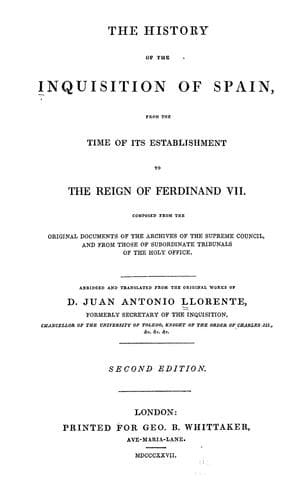
The History of the Inquisition of Spain from the Time of its Establishment to the Reign of Ferdinand VII.Llorente, Juan Antonio
History
The History of the Inquisition of Spain from the Time of its Establishment to the Reign of Ferdinand VII.
Llorente, Juan Antonio
Inquisition -- Spain
Deza was at the head of the Inquisition eight years. If the calculation
of his victims is formed after the inscription at Seville, we shall find
that 38,440 persons were punished during that time, of whom 2592 were
burnt in person, 896 in effigy, and 34,952 condemned to different
penances. Among this crowd of persons who were persecuted by the
Inquisition, there were many distinguished by their birth, their
learning, their fortunes, and their offices. The sanguinary inquisitor,
Lucero, made the venerable Don Ferdinand de Talavera, first Archbishop
of Grenada, the object of a shameful persecution. He became jealous of
the reputation for sanctity and charity which this prelate had acquired,
and raised doubts of his faith, by reminding Isabella, that he had
opposed the establishment of the Inquisition in 1478, and the following
years; and by publishing that, although his father was noble, and of the
illustrious family of Contreras, yet he was of Jewish origin by the
mother's side. The inquisitor concluded from these circumstances that he
could commence a _secret instruction_ against the holy prelate. Deza
commissioned the Archbishop of Toledo, Ximenez de Cisneros, to receive
the preparatory informations on the faith of the Archbishop of Grenada;
Cisneros informed the Pope of the commission which he had received, and
the pontiff commanded his apostolical nuncio, the Bishop of Bristol, to
take the affair under his direction, and prohibited Deza and the
Inquisitors from pursuing it. The Pope, in a Council of Cardinals and
Bishops, acquitted the Archbishop of Grenada, who died in 1507, some
months after this judgment, after three years of the greatest anxiety,
as the inquisitor Lucero had caused many of his relations to be
arrested, although they were all innocent.
The persecution suffered by the learned Antonio Lebrija was not less
cruel. He had been tutor to Isabella, and was honoured by the friendship
and protection of Ximenez de Cisneros: he was well acquainted with the
Greek and Hebrew, and discovered and corrected in the Latin text of the
Vulgate some errors which had been committed by the transcribers before
the invention of printing. He was accused by some scholastic
theologians; his papers were seized, and after being treated with the
greatest cruelty, he had the grief of seeing the suspicion of heresy
established against him, and was obliged to live in that species of
disgrace until he could write his apology under the protection of
Ximenez de Cisneros.
Public-domain text, read in full here on John Shaqi.
Reviews
Reviews
No reviews yet
Be the first to share your thoughts on this work.
Elsewhere in the archive
Join the Discussion
Join the discussion
Sign in to leave a comment or review.
Sign InorCreate an account