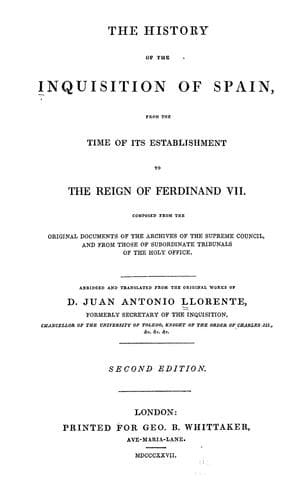
The History of the Inquisition of Spain from the Time of its Establishment to the Reign of Ferdinand VII.Llorente, Juan Antonio
History
The History of the Inquisition of Spain from the Time of its Establishment to the Reign of Ferdinand VII.
Llorente, Juan Antonio
Inquisition -- Spain
The moderation and exhortations of Ximenez de Cisneros, Archbishop of
Toledo, and Don Ferdinand de Talavera, had converted more than 50,000
Moors, and the conversions would have been still more numerous, if some
priests had not treated the Moors with severity, and excited a general
revolt.
In 1501 the sovereigns declared in an edict, that by the grace of God,
there were no infidels in the kingdom of Grenada, and to render the
conversions more secure, they forbade any Moors to enter the territory;
they also prohibited the slaves of that nation from holding any
communication with others, that their conversion might not be retarded,
or with those who had been baptized, as they might induce them to
apostatize. All who did not conform to these laws incurred the
punishment of death.
In February, 1502, Ferdinand and Isabella commanded all the free Moors
of both sexes, above fourteen and twelve years of age, to quit the
kingdom of Spain before the month of May following: they were allowed to
sell their goods as the Jews had been; but were prohibited from going to
Africa, which was then at war with Spain. The states of the Grand
Seignior and other countries were assigned to them as places of refuge:
as several baptized Moors sold their property and went to Africa, a
royal ordinance was published, importing that, for the space of two
years, no person could sell his property, or leave the kingdom of
Castile, except to go into Aragon or Portugal, without a permission,
which would only be granted to those who gave a security for their
return when they had terminated their affairs.
Deza was not contented with exciting the zeal of Ferdinand and Isabella
against the Moors; he also proposed measures against the Jews on the
occasion of the arrival of different strangers in Spain, but who were
not of those expelled in 1492. He obtained a royal ordinance in 1499,
which applied those measures to them which had been established against
the first Jews. The council of the Inquisition had already decreed that
the converted Jews should be obliged to prove their baptism, and that
they lived with the other Christians; that those who had been rabbins or
masters of the law should be obliged to change the place of their
residence; that they should appear every Sunday and on festival days in
the churches, and be carefully instructed in the christian doctrine.
Ferdinand permitted the inquisitors of Aragon to take cognizance of
usury and other crimes foreign to their jurisdiction, contrary to the
oath which he had taken to observe the laws of that kingdom, which
ordained that they should be punished by the secular judge.
Public-domain text, read in full here on John Shaqi.
Reviews
Reviews
No reviews yet
Be the first to share your thoughts on this work.
Elsewhere in the archive
Join the Discussion
Join the discussion
Sign in to leave a comment or review.
Sign InorCreate an account