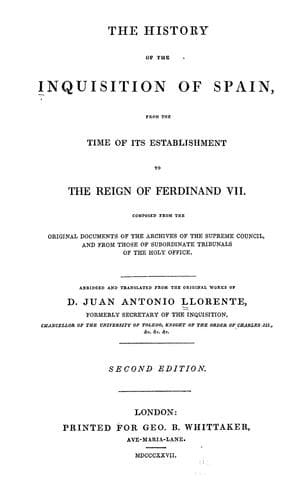
The History of the Inquisition of Spain from the Time of its Establishment to the Reign of Ferdinand VII.Llorente, Juan Antonio
History
The History of the Inquisition of Spain from the Time of its Establishment to the Reign of Ferdinand VII.
Llorente, Juan Antonio
Inquisition -- Spain
Charles, his grandson, resided in Flanders, but he sent into Spain
several men who enjoyed his confidence: amongst them were his governor,
the Duke d'Ariscot, and Adrian de Florencio, who was Dean of Louvain,
and born at Utrecht. As the two sovereignties of Castile and Aragon were
now united, it appeared natural that there should be but one
inquisitor-general for the monarchy, but Cisneros had too much
penetration to omit this opportunity of recommending himself to the
favorite, and, consequently, to the prince. Instead of demanding this
union, he wrote to the king to represent that it appeared to him
expedient to bestow the bishopric of Tortosa and the office of
inquisitor-general of Aragon on the Dean of Louvain, and it was easy to
obviate the difficulty of his being a foreigner by giving him letters of
naturalization. This plan was executed; the double nomination was sent
to Rome, and the Pope granted the bulls. Adrian took possession of
Majorca on the 7th of February, 1517: this nomination was followed by
one to the office of Cisneros, who died on the 6th of November
following. Although he was elected Pope on the 9th of January, 1522, he
continued in his office until the 10th of September in the following
year, when he signed the bulls of his successor, Don Alphonso Manrique
de Lara, Archbishop of Seville.
During the period that the Inquisition remained separate from that of
Castile, it was often violently attacked, and more than once was on the
point of being abolished, or at least subjected to a reform, which would
have left it without the power of exciting terror. Ferdinand having
assembled the Cortes of the kingdom at Monzon, in 1510, the deputies of
the towns and cities loudly complained that the inquisitors abused their
powers, not only in matters of faith, but in several points which were
not in their jurisdiction. The deputies also represented, that they
interfered in the regulation of the contributions, and that the taxes
were shamefully diminished by the reductions which they made in the
lists; that their authority had made them so bold and insolent, that
they created themselves judges in all doubtful cases; and where their
competence was denied, they had recourse to excommunication; that they
oppressed the magistrates, who feared that they should be obliged to do
public penance in an _auto-da-fé_; that this misfortune had already
happened to the viceroys and governors of Barcelona, Valencia, Majorca,
Sardinia, and Sicily, and to several persons of high rank; in
consequence, they entreated his Majesty to maintain the execution of the
laws and statues of the kingdom of Aragon, and to oblige the officers of
the Inquisition to confine themselves to matter of faith, and to pursue
them according to the rules of common law, in giving them the publicity
of criminal proceedings.
Public-domain text, read in full here on John Shaqi.
Reviews
Reviews
No reviews yet
Be the first to share your thoughts on this work.
Elsewhere in the archive
Join the Discussion
Join the discussion
Sign in to leave a comment or review.
Sign InorCreate an account