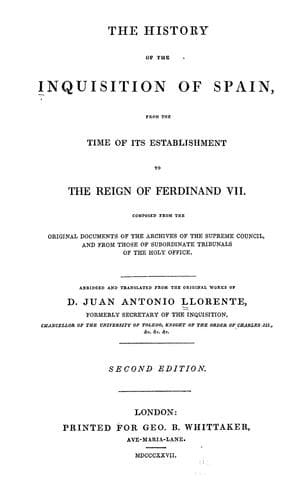
The History of the Inquisition of Spain from the Time of its Establishment to the Reign of Ferdinand VII.Llorente, Juan Antonio
History
The History of the Inquisition of Spain from the Time of its Establishment to the Reign of Ferdinand VII.
Llorente, Juan Antonio
Inquisition -- Spain
This representation of the Cortes acquainted the king with the
disposition of the public; yet he avoided giving a direct reply, and
said that it was impossible to decide upon so important an affair
without having acquired a profound knowledge of facts; that he requested
them to collect all that came to their knowledge, and to lay them before
him in the first assembly. This took place in the same town, in 1512.
The resolutions which were then adopted form a treaty between the
sovereign and his people: it contains twenty-five articles, all tending
to restrain the extent of the jurisdiction of the inquisitors.
It was there stated that they could not interfere in trials for bigamy
and usury, unless the culprits had fallen into the crime of heresy in
asserting that these offences were not sinful; nor in the proceedings
instituted against blasphemers by other tribunals, unless the blasphemy
was heretical: they were also prohibited from proceeding in a trial
without the concurrence of the _ordinaire diocesan_: the
inquisitor-general was likewise restrained from pronouncing judgment in
cases of appeal without the consent of his counsellors; and that the
execution of the sentence which had caused it should be delayed. No
measures were taken for the publicity of the proceedings, or with regard
to the confiscations; but it was agreed that the contracts and other
engagements, signed by one who had the reputation of a good catholic,
should be valid, although he should be afterwards proved to have been a
heretic at the time of the transaction.
The king soon repented of having given his word to the Cortes; and,
seconded by the intrigues of the inquisitors, he solicited and obtained
a dispensation from his promise, on the 30th of April, 1513. One of the
clauses of the dispensation reinstates the tribunals of the holy office
in all the privileges which they had formerly possessed. This conduct
of the king caused a general revolt; and he was obliged to request the
Pope to confirm the regulations of the Cortes, and subject those who did
not conform to them to the censure of the church. The Pope saw the
necessity of compliance, and granted the bull in 1515.
CHAPTER XI.
AN ATTEMPT MADE BY THE CORTES OF CASTILE AND ARAGON TO REFORM THE
INQUISITION.--OF THE PRINCIPAL EVENTS UNDER ADRIAN, FOURTH
INQUISITOR-GENERAL.
Public-domain text, read in full here on John Shaqi.
Reviews
Reviews
No reviews yet
Be the first to share your thoughts on this work.
Elsewhere in the archive
Join the Discussion
Join the discussion
Sign in to leave a comment or review.
Sign InorCreate an account