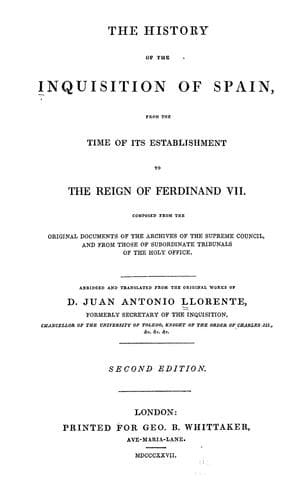
The History of the Inquisition of Spain from the Time of its Establishment to the Reign of Ferdinand VII.Llorente, Juan Antonio
History
The History of the Inquisition of Spain from the Time of its Establishment to the Reign of Ferdinand VII.
Llorente, Juan Antonio
Inquisition -- Spain
The Inquisition was never in so much danger as during the first year of
the reign of Charles V. When the young monarch arrived in Spain, he was
disposed to abolish the Inquisition, or at least to regulate the
proceedings according to those of other tribunals. In 1518 a general
assembly of the Cortes was held at Valladolid, when the representatives
solicited that his highness would command the office of the holy
Inquisition to conform to the rules of the canons and the common law.
The Cortes likewise sent ten thousand pieces of gold to the chancellor
Selvagio, and promised the same sum when the decree which they solicited
should be put in execution. The king replied that he would take proper
measures to remedy the evil of which they complained: in consequence, he
engaged the Cortes to publish the abuses which had been introduced, and
to indicate the means of abolishing them.
When the assembly at Valladolid had terminated their labours, Charles
convoked the Cortes of Aragon at Saragossa, where he was accompanied by
the chancellor Selvagio, who had prepared a royal ordinance, to be
published according to the demand of the Cortes of Castile. It was
composed of thirty-nine articles: the proceedings of the tribunal were
regulated in it, with the ages, the rank, and salaries of the judges and
subaltern officers.
The result of this new code was, that the inquisitors could not question
a witness to obtain information on any subject but that for which he was
summoned.
That each denouncer should be subject to a strict examination, to
discover his motives for the accusation.
That the order for imprisonment could not be given without the
concurrence of the diocesan in ordinary, or until they had examined each
witness a second time.
That the prisons should be public, neat, and convenient.
That the prisoners should be allowed to see their relations, their
friends, and their counsel.
That they might choose a lawyer or procurator in whom they placed
confidence.
That the accusation should be immediately communicated to them, with the
name of the place where, and the time when, the witnesses had declared
the crime to have been committed.
That if the accused demanded a copy of the accusation and the
examination, it should be given to him.
That when the proofs and the depositions were all received, they should
be communicated entirely to the prisoner, _as in the present time there
are no persons powerful enough to inspire the witnesses with fear,
except in cases where the prisoner is a duke, marquis, count, bishop, or
in possession of some other dignity of the church_.
That in this case, in order to conceal the names of the witnesses, the
judge shall draw up a writing, declaring upon oath, that he believes
this measure to be necessary for the preservation of the lives of the
witnesses; that this act shall deprive the prisoner of his right of
appealing against it.
Public-domain text, read in full here on John Shaqi.
Reviews
Reviews
No reviews yet
Be the first to share your thoughts on this work.
Elsewhere in the archive
Join the Discussion
Join the discussion
Sign in to leave a comment or review.
Sign InorCreate an account