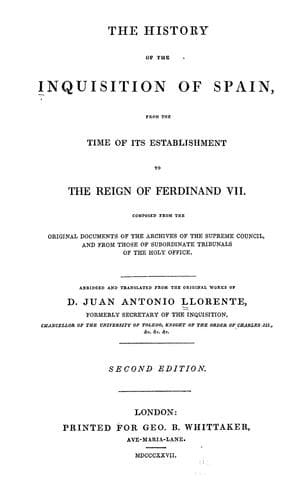
The History of the Inquisition of Spain from the Time of its Establishment to the Reign of Ferdinand VII.Llorente, Juan Antonio
History
The History of the Inquisition of Spain from the Time of its Establishment to the Reign of Ferdinand VII.
Llorente, Juan Antonio
Inquisition -- Spain
That until this bull is obtained, the king shall be requested to command
the inquisitors to conform to these regulations, in the trials already
commenced, and in those which may begin from this time.
This excellent code of laws was never put in execution, because the
chancellor Selvagio, who framed it, died before its publication; and
Cardinal Adrian so totally changed the ideas and inclinations of Charles
V. that he became an ardent defender of the Inquisition.
Charles V. had sworn at Saragossa, in 1518, to respect the privileges
and customs of the Aragonese, particularly the resolutions of the Cortes
at Saragossa, Tarazona, and Monzon, and consequently that he would not
suffer the inquisitors to commence any trials for usury.
But a new assembly of the Cortes having been convoked at Saragossa,
towards the end of the year 1518, the deputies of Aragon represented to
the king, that the agreement of the Cortes at Monzon, in 1512, was not
sufficient to remedy the abuses which the inquisitors had introduced;
they therefore entreated his Majesty to add to it thirty-one articles
which they had adopted. These articles differed little from those of the
Cortes of Castile.
The king, after having consulted his council, replied, "_that it was his
pleasure that the holy canons, and the decrees of the holy see, should
be conformed to in regard to all the articles which had been presented
to him. That if difficulties or doubts should occur, which required
explanation, they should apply to the Pope_; that if any person wished
to accuse an inquisitor of abuse in the exercise of his office, he might
do so by applying to the inquisitor-general, who would pronounce
sentence according to equity; and that the king would cause them to be
punished as an example; _that he engaged by oath to observe himself, and
cause others to observe, the order and declaration which he addressed to
the assembly, as well as the articles which the Pope might add to those
of the Cortes_; that he also promised, upon oath, never to demand a
dispensation from his promise; and that if one was addressed to him he
would never make use of it, as he at that time renounced all the rights
which might arise from it."
This reply induced the Cortes to believe that the king had granted all
their requests; they considered that the trials would be there conducted
as before other ecclesiastical tribunals. Persuaded that this was the
king's intention, the Cortes resolved to show their gratitude by a
voluntary contribution of money.
Public-domain text, read in full here on John Shaqi.
Reviews
Reviews
No reviews yet
Be the first to share your thoughts on this work.
Elsewhere in the archive
Join the Discussion
Join the discussion
Sign in to leave a comment or review.
Sign InorCreate an account