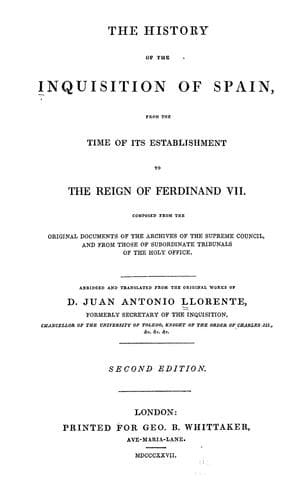
The History of the Inquisition of Spain from the Time of its Establishment to the Reign of Ferdinand VII.Llorente, Juan Antonio
History
The History of the Inquisition of Spain from the Time of its Establishment to the Reign of Ferdinand VII.
Llorente, Juan Antonio
Inquisition -- Spain
Some time elapsed before the agreement was approved by the Pope. The
Emperor wrote the following letter from Cologne, in 1520, to his
ambassador at Rome:--"In regard to the transactions of the Cortes, it
will be sufficient if his Holiness will approve an act sent to Don Louiz
Carroz, and afterwards to Don Jerome Vich, which is written by the hand
of the venerable Cardinal of Tortosa, and that of the great chancellor,
without any extension or interpretation, as I have often demanded
earnestly."
The Aragonese, who did not even believe it possible to obtain this last
point, entreated the inquisitor-general to command the inquisitors of
Saragossa to conform immediately to the regulations of the agreement,
without waiting for the confirmation of the Pope, because almost all the
articles were the same as those in the convention of 1512, which the
Pope had approved.
Cardinal Adrian complied with the request, and wrote to the inquisitors.
They replied, that they thought themselves obliged to take the orders of
the king before they obeyed him. Charles addressed an ordinance to them,
in which he commanded them to execute all that he had promised and sworn
in the preceding year.
At last the Pope confirmed the resolutions by a bull, which was
proclaimed with great solemnity. However, it soon appeared that this
publication would have no effect, because the promise of the king was,
that the canons and apostolical ordinances should be strictly observed
in regard to the articles; and in conforming to this they only executed
the bull of 1515.
On the 21st of January, 1521, the Emperor ordered the secretary of the
Cortes to be set at liberty; for although the inquisitor-general, in
1520, had decreed that he should be _relaxed_, and the prisoner had been
informed of it, yet he refused to quit the prison, affirming that the
decree which set him at liberty, tended more to make him appear guilty
than innocent, by the use of the word _relaxed_.
Similar debates took place in Catalonia, where the king convoked a
Cortes at Barcelona, in 1519, to take the oath of maintaining the
privileges of the province. The Catalans, informed of the effect
produced by the representations of the Cortes of Aragon, likewise
demanded a reform of several abuses of their Inquisition relative to the
taxes, as well as usury, bigamy, and other crimes of that class. The
king, after having heard their remonstrances, made nearly the same reply
as to the Cortes of Saragossa, and wrote to the Pope to demand a
ratification of the articles. The Pope approved them in a bull in 1520;
but Charles did not wait for its arrival to enforce the execution of his
promise, which is proved by his order to Don Diego de Mendoza, his
lieutenant-general in Catalonia. Yet he declares in his letter to his
lieutenant, that he only made these promises _on account of the
importunities of some representatives_ of towns, and some _men who were
among the members of the Cortes_.
Public-domain text, read in full here on John Shaqi.
Reviews
Reviews
No reviews yet
Be the first to share your thoughts on this work.
Elsewhere in the archive
Join the Discussion
Join the discussion
Sign in to leave a comment or review.
Sign InorCreate an account