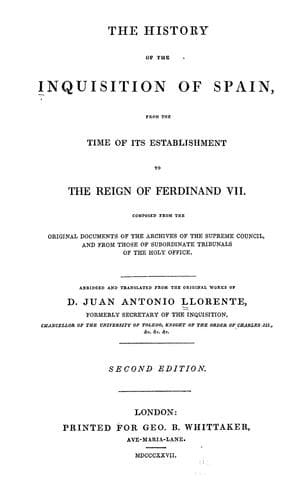
The History of the Inquisition of Spain from the Time of its Establishment to the Reign of Ferdinand VII.Llorente, Juan Antonio
History
The History of the Inquisition of Spain from the Time of its Establishment to the Reign of Ferdinand VII.
Llorente, Juan Antonio
Inquisition -- Spain
This brief offended the deputies, but they continued their importunities
at the Court of Rome with so much ardour, that their credit balanced the
power of Charles V.; and though they did not obtain the extension of the
articles, they prevented the revocation of the reforming briefs, and
Charles was obliged to be satisfied with that addressed to Cardinal
Adrian.
Leo X. died on the 1st of December, 1521, and Cardinal Adrian succeeded
him on the 9th of January, 1522: he did not quit his office of
inquisitor-general until the 10th of September, 1523, when he bestowed
it on Don Alphonso Manrique, Archbishop of Seville.
According to the most moderate calculation from the inscription at
Seville, it appears that 240,025 persons were condemned by the
Inquisition during the five years of the ministry of Adrian; 1620 were
burnt in person; 560 in effigy; and 21,845 subjected to different
penances. If the year 1523, which may be considered as an interregnum
until the inscription of Seville, which is of the year 1524, is added to
this, the number of victims sacrificed by the Inquisition may be
estimated at 234,526 persons, an immense number, though it is far below
the truth.
CHAPTER XII.
CONDUCT OF THE INQUISITORS TOWARDS THE MORESCOES.
The New Christians of Jewish origin flattered themselves, at the
commencement of the ministry of Don Alphonso Manrique, that they should
obtain the publication of the names and charges of the witnesses, as he
had supported their request in 1516: but the inquisitors persuaded him
that such a proceeding tended to the destruction of the holy office, and
the triumph of the enemies of the faith; and that the appearance of two
new sects of _Morescoes_ and _Lutherans_ rendered a great degree of
severity indispensable.
It has been already stated, that an order from Ferdinand and Isabella,
in 1502, had compelled all those Moors who refused to become Christians,
to quit Spain. Although this law was executed in Castile, it did not
affect the Moors of Aragon, as the King had yielded to the solicitations
of the nobles, who represented the immense injury which it would do
them, in destroying the population of their domains, where there were
scarcely any baptized inhabitants.
The two sovereigns renewed their promise in 1510, and Charles V. took an
oath to the same effect in the Cortes of Saragossa in 1519.
Public-domain text, read in full here on John Shaqi.
Reviews
Reviews
No reviews yet
Be the first to share your thoughts on this work.
Elsewhere in the archive
Join the Discussion
Join the discussion
Sign in to leave a comment or review.
Sign InorCreate an account