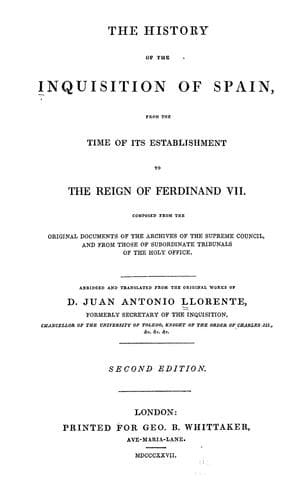
The History of the Inquisition of Spain from the Time of its Establishment to the Reign of Ferdinand VII.Llorente, Juan Antonio
History
The History of the Inquisition of Spain from the Time of its Establishment to the Reign of Ferdinand VII.
Llorente, Juan Antonio
Inquisition -- Spain
The deputation of the Cortes sent commissioners to Barcelona, to say
that the sum of money offered to the king was conditional, and at the
same time convoked the _tiers-état_. Charles being informed of it,
commanded the dissolution of the assembly, which replied, that the kings
of Aragon had no right to use so violent a measure, without the consent
of the people; it decreed that the levy should not be raised, and
applied to the Court of Rome for the ratification of the articles of
Saragossa.
Leo X. was at that time displeased with the Inquisition of Spain, on
account of its refusal to admit certain briefs of inhibition in the
tribunals of Toledo, Seville, Valencia, and Sicily; and forgetting the
consideration which he owed to Charles (who was then emperor of
Germany), he resolved to reform the holy office, and to compel it to
submit to the rules of common law.
In consequence of this resolution he expedited three briefs addressed to
the king, the cardinal inquisitor-general, and the inquisitors of
Saragossa, in which, after explaining his intention, he decrees that the
inquisitors shall be deprived of their offices, and that the bishops and
their chapters should present two canons to the inquisitor-general, who
should appoint one: he added that this choice should be confirmed by the
holy see, and that these new inquisitors should be subjected every two
years to a judicial censure.
The deputies received these briefs, and immediately required the
inquisitors to conform to them; they replied that they would await the
orders of their immediate chief. The king wrote to his uncle Don
Alphonso of Aragon, Archbishop of Saragossa, to enter into an agreement
with the deputies, and at the same time he sent an
ambassador-extraordinary to Rome to demand a revocation of the briefs.
The Aragonese then promised to levy the supply if the secretary Prat was
liberated, but protested that they would not admit any proposition
contrary to the promise which the king had made.
This prince instructed his ambassador to inform the Pope of all that had
passed in the Cortes of Castile, but to keep silence on the most
important circumstances, and to assure his Holiness that no complaints
had been made of the Inquisition since Cardinal Adrian had been
inquisitor-general. Charles also required that no brief should be
expedited to cause the _San-benitos_ to be removed from the churches, or
to prohibit them from being worn in the streets.
The Pope, seeing the importance which Charles attached to these things,
wrote to Cardinal Adrian, that although he was perfectly informed of all
that was passing, and that he had resolved to do justice to the claims
of the Cortes, yet he would not carry the affair further without the
consent of the King, to whom he promised to make no innovations; but he
requested him to pay great attention to what was passing, as he heard
serious complaints every day from all parts of the kingdom, of the
avarice and injustice of the inquisitors.
Public-domain text, read in full here on John Shaqi.
Reviews
Reviews
No reviews yet
Be the first to share your thoughts on this work.
Elsewhere in the archive
Join the Discussion
Join the discussion
Sign in to leave a comment or review.
Sign InorCreate an account