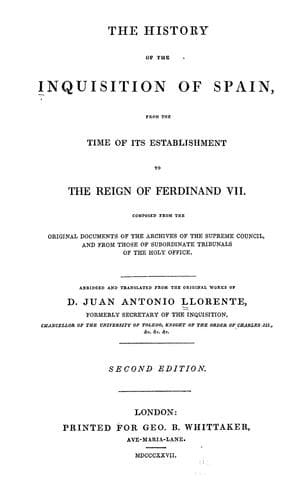
The History of the Inquisition of Spain from the Time of its Establishment to the Reign of Ferdinand VII.Llorente, Juan Antonio
History
The History of the Inquisition of Spain from the Time of its Establishment to the Reign of Ferdinand VII.
Llorente, Juan Antonio
Inquisition -- Spain
In the year 1558 the terrible law of Philip II. was published, which
decreed the punishments of death and confiscation for all those who
should sell, buy, keep, or read, the books prohibited by the holy
office; and, to ensure the execution of this sanguinary law, the index
was printed, that the people might not allege ignorance in their
defence.
A bull of 1559 enjoins confessors to interrogate their penitents on this
subject, and to remind them that they were obliged to denounce the
guilty on pain of excommunication. A particular article subjects the
confessors to the same punishment if they neglected this duty, even if
their penitents were of the highest rank.
This severe law was however mitigated in 1561, when the Cardinal of
Alexandria, inquisitor-general of Rome, published a decree, announcing,
in the name of Pius. IV., that some of the prohibitions of books had
been withdrawn. This decree also granted permission to read and possess
some books which had been suppressed only because they were written by
heretics.
Valdes, the inquisitor-general of Spain, immediately wrote to the
inquisitors of the provinces, to suspend the execution of the edict,
until he had received the orders of the king, to whom he had represented
the danger arising from a measure which annulled the punishment of
excommunication; but Valdes had another motive in the proceeding.
In 1559, this inquisitor had published a printed catalogue of prohibited
books, which was much more extended than that of 1558, and in which,
according to the advice of Francis Sanchez, he had introduced all the
works mentioned in the catalogues of Rome, Lisbon, Louvain, and those of
Spain of an earlier date. He divided them into six classes. The first
consisted of Latin books; the second of those written in Castilian; the
third of those in the Teutonic language; the fourth of German books; the
fifth of French; and the sixth of Portuguese. Valdes, in a note at the
end of his index, gave notice that there were many books subject to the
prohibition, not mentioned in the list, but that they would be added.
He appointed the punishment of excommunication, and a penalty of two
hundred ducats, for those persons who should read any of these books,
and in this number were included some which were permitted to be read by
the last edict of the Pope.
Valdes had inserted in his catalogue some books which had not only been
considered catholic, but were in the hands of everybody and full of true
piety, particularly some works of Don Hernand de Talavera, the venerable
Juan d'Avila, Bartholomew Carranza de Miranda, Archbishop of Toledo;
Hernand de Villegas, Louis de Granada, a Dominican; and St. Francis
Borgia.
Public-domain text, read in full here on John Shaqi.
Reviews
Reviews
No reviews yet
Be the first to share your thoughts on this work.
Elsewhere in the archive
Join the Discussion
Join the discussion
Sign in to leave a comment or review.
Sign InorCreate an account