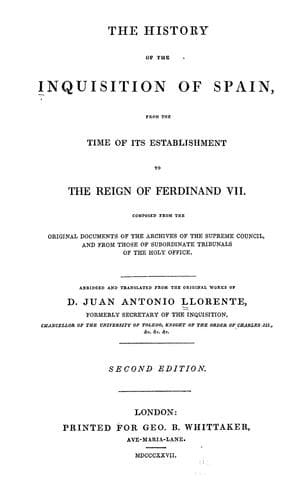
The History of the Inquisition of Spain from the Time of its Establishment to the Reign of Ferdinand VII.Llorente, Juan Antonio
History
The History of the Inquisition of Spain from the Time of its Establishment to the Reign of Ferdinand VII.
Llorente, Juan Antonio
Inquisition -- Spain
Although Charles V. and Philip II. neglected nothing that could prevent
the introduction of prohibited books into Spain, several which were
favourable to the Lutheran heresy penetrated into the kingdom. In 1558
the inquisitor-general published an edict more severe than any of the
preceding; and also drew up an instruction for the use of the
inquisitors; importing, that all books mentioned in the printed
catalogue should be seized; that a public _auto-da-fé_ should be made of
those tending to heresy; that the commentaries and notes attributed to
Melancthon should be suppressed in all the treatises on grammar where
they were introduced; that the bibles marked as being suspected should
be examined; that no books should be seized except those mentioned in
the list; that all the books printed in Germany since 1519 without the
name of the author should be examined; that the translation of
_Theophylact_ by _OEcolampadius_ should be seized; likewise some
volumes of the works of St. John Chrysostom, which had been translated
by that arch-heretic and _Wolfang Nusculus_; that the commentaries by
heretics on works composed by catholics should be suppressed; and that a
book on medicine might be seized, although it was not mentioned in the
index.
When this edict was published, Francis Sanchez, professor of theology in
the university of Salamanca, wrote to inform the Supreme Council, that
he had occupied himself for several years in examining dangerous books,
and gave his opinion on the course which ought to be pursued.
The council, in consequence, decreed that those theologians in the
university who had studied the Oriental languages, should be obliged, as
well as other persons, to give up their Hebrew and Greek Bibles to the
commissaries of the holy office, on pain of excommunication; that the
proprietors of Greek, Arabic, and Hebrew books, not mentioned in the
list, should not be molested; that the order concerning the books
printed without the name of the author, related only to modern
productions; that the request made by some persons to be allowed to keep
_Pomponius Mela_, with the commentary of _Nadicano_, should be refused;
that these books should be remitted to the council to be examined; that
the order to seize all works containing errors should only be applied to
modern books; and that the _Summa Armata_ of Durand, of Cajetan, Peter
Lombard, Origen, Theophylact, Tertullian, Lactantius, Lucian, Aristotle,
Plato, Seneca, and other authors of that class, should be allowed to
circulate; that the council, being informed that several catalogues of
prohibited books existed, would unite them, and compose one general
catalogue.
Public-domain text, read in full here on John Shaqi.
Reviews
Reviews
No reviews yet
Be the first to share your thoughts on this work.
Elsewhere in the archive
Join the Discussion
Join the discussion
Sign in to leave a comment or review.
Sign InorCreate an account