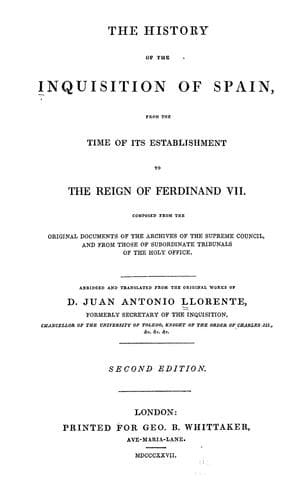
The History of the Inquisition of Spain from the Time of its Establishment to the Reign of Ferdinand VII.Llorente, Juan Antonio
History
The History of the Inquisition of Spain from the Time of its Establishment to the Reign of Ferdinand VII.
Llorente, Juan Antonio
Inquisition -- Spain
In 1567 the council commanded the theological works of Brother John
Fero, a Franciscan of Italy, to be seized, with the notes and
corrections of Brother Michael de Medina, and some other works of the
same author, who ended his days in the dungeons of the Inquisition in
1578, before his sentence had been pronounced. After his death, his
_Apology for John Fero_ was inserted in the expurgatory index.
In 1568 the Supreme Council charged the officers of the Inquisition to
watch the frontiers of Guipuscoa, Navarre, Aragon, and Catalonia, with
the greatest vigilance, to prevent the introduction of prohibited books.
This resolution was adopted, because information had been received that
a great number of Lutheran books in the Castilian tongue were packed and
sent in hogsheads of the wines of Champagne and Burgundy, with so much
art, that the officers of the customs could not discover the deception.
In 1570 the council prohibited a work on the Pentateuch by Brother
Jerome de Holcastro; and the _Petit Office_, printed at Paris in 1556.
The motive for this suppression was singular: the frontispiece was
decorated with a cross and a swan, with the motto, "IN HOC CIGNO
VINCES." It is plain that the _Petit Office_ was prohibited, because a C
was used instead of the S in the word _signo_. The same severity was
shewn in all cases where the books had this symbol, or any allegories of
that nature.
In 1571 the inquisitors caused a Spanish Bible, printed at Baste, to be
seized, and Philip II. wrote to the Duke of Alva, the governor of the
Low Countries, to compose an index for the use of the Flemish people,
with the assistance of the learned Arias Montanus. He presided in an
assembly of theologians, who judged that the new index should only
consist of the Latin prohibited by the Inquisition, or which it was
necessary to correct. This measure was applied only to some well-known
authors who were dead, and to some others, still living; but more
particularly to the works of Erasmus, and with circumstances which might
lead to the supposition, that his books were the principal objects of
the prohibition, and that of the other authors merely a pretext to
conceal the injury done to him. This catalogue was printed at Antwerp in
1571, with a preface by Arias Montanus, a royal decree and a
proclamation of the Duke of Alva enforcing the execution of it. This
list is known by the name of the _Expurgatory Index of the Duke of
Alva_. The holy office had no part in this affair, as the Flemings had
refused to recognise their authority.
In 1582 the inquisitor-general, Don Gaspard de Quiroga, published a new
_Prohibitory Index_. It is remarkable _that the Index of his predecessor
Valdes is mentioned in this list_.
That which was published in 1584 was drawn up by Juan de Mariana, who
soon after had some of his own works prohibited. In 1611, a new index
was formed under the inquisitor-general Don Bernard de Roxas de
Sandoval.
Public-domain text, read in full here on John Shaqi.
Reviews
Reviews
No reviews yet
Be the first to share your thoughts on this work.
Elsewhere in the archive
Join the Discussion
Join the discussion
Sign in to leave a comment or review.
Sign InorCreate an account