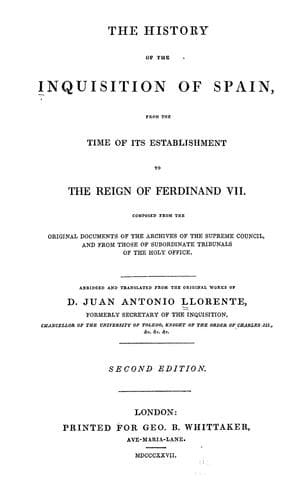
The History of the Inquisition of Spain from the Time of its Establishment to the Reign of Ferdinand VII.Llorente, Juan Antonio
History
The History of the Inquisition of Spain from the Time of its Establishment to the Reign of Ferdinand VII.
Llorente, Juan Antonio
Inquisition -- Spain
The Cardinal Zapata, who succeeded Roxas, adopted one more extended in
1620, and it was used by his successor, Don Antonio de Sotomayer, in
1630. This catalogue was the first which the inquisitors presumed to
publish from their own authority, and without being commissioned by
government. Don Diego Sarmiento Valladares, inquisitor-general, in 1681,
began to reprint it with additions, and it was finished by Don Vidal
Marin, who published it in 1707.
Don Francis Perez del Prado, another inquisitor-general, commissioned
the Jesuits Casani and Carrasco to compose a new catalogue. Although
these monks were not authorized by the Supreme Council, they inserted in
the list all the books which they supposed to be favourable to the
Jansenists, Baius and Father Quesnel. Their conduct was denounced to the
Supreme Council by the Dominican Concina, and some other monks; the
Jesuits were examined, and defended themselves: the council, though it
could not approve, did not carry the affair further; it had not
sufficient power to balance the influence of the Jesuit Francis Rabago,
who was confessor to Ferdinand VI.
Among the books which they prohibited were the works of Cardinal
_Norris_, which were held in general estimation by the learned
throughout Christendom. Benedict XIV., in 1748, addressed a brief to the
inquisitor-general, commanding him to revoke the prohibition; as this
order was not obeyed, the Pope complained to the king, but was unable to
obtain his request until ten years after, when the Jesuit Rabago no
longer directed the conscience of the monarch.
The index of the Jesuits also contained several treatises of the
venerable Don Juan de Palafox y Mendoza, Archbishop and Viceroy of
Mexico. The congregation of rites afterwards declared that there was
nothing in them worthy of censure, and the inquisitor-general was
obliged to revoke the prohibition in an edict, the copies of which were
immediately bought up by some friends of the Jesuits. To give an idea of
the criticism of Perez del Prado, it is sufficient to say that he
bitterly lamented the misfortunes of the age he lived in, saying, "_That
some individuals had carried their audacity to the execrable extremity
of demanding permission to read the Holy Scriptures in the vulgar
tongue_, without _fearing to encounter mortal poison therein_."
In 1792 a new index was published, without the consent, and even in
opposition to the Supreme Council, by Don Augustine Rubin de Cevallos,
inquisitor-general. It is this index which is still in force, but the
prohibitions and expurgatory measures have since been multiplied.
Public-domain text, read in full here on John Shaqi.
Reviews
Reviews
No reviews yet
Be the first to share your thoughts on this work.
Elsewhere in the archive
Join the Discussion
Join the discussion
Sign in to leave a comment or review.
Sign InorCreate an account