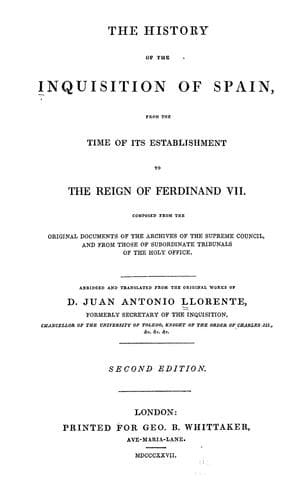
The History of the Inquisition of Spain from the Time of its Establishment to the Reign of Ferdinand VII.Llorente, Juan Antonio
History
The History of the Inquisition of Spain from the Time of its Establishment to the Reign of Ferdinand VII.
Llorente, Juan Antonio
Inquisition -- Spain
The prohibitory decrees are preceded by _qualification_. The process is
instituted before the supreme council; but as the information is
generally laid before the inquisitors of the court, they appoint the
qualifiers who censure the book. A copy of the work and the denunciation
is sent to the first qualifier, and afterwards to the second, unsigned
by the opinion of the first; if they do not accord, copies are sent a
third time before it is submitted to the Supreme Council. The
inquisitors of the provinces have likewise the privilege of receiving
informations: they proceed in the same manner; but the council always
commission the inquisitors of the court to censure books, because they
were more sure of their qualifiers.
If any person presumed to buy, keep, or read prohibited books, he
rendered himself liable to be suspected of heresy by the inquisitors,
although it might not be proved that he became an heretic from such
reading; he incurred the punishment of major excommunication, and was
proceeded against by the tribunal: the result of this action was the
absolution _ad cautelam_.
During the last years of the eighteenth century, no person has been
imprisoned for reading prohibited books, unless he was convicted of
having advanced or written heretical propositions. The punishment
inflicted was merely a pecuniary penalty, and a declaration that the
individual was slightly suspected of heresy; it must be acknowledged
that this qualification was omitted, if there was any reason to suppose
that the accused had erred from motives of curiosity, and not from a
tendency to false doctrine. Nevertheless all these proceedings are
arbitrary, and the inquisitors have the power of pursuing the infringers
of this law as if they were heretics.
The permission to read prohibited books, rendered all actions instituted
against those who violated the law ineffectual. The Pope granted it for
a sum of money, without inquiring if the person who demanded it was
capable of abusing the permission. The inquisitor-general of Spain acted
with more prudence; he took secret informations on the conduct of the
solicitor, and required him to state in writing the object of his
demand, and the subject on which he wished to consult the prohibited
books. Where the permission granted was general, the books mentioned in
the edicts were excepted. In this sense the works of Rousseau,
Montesquieu, Mirabeau, Diderot, d'Alembert, Voltaire, and several other
modern philosophers, among whom was Filangieri, were excepted from the
privilege. During the last years of the Inquisition, the permissions
granted by the Court of Rome did not defend the persons who received
them from the inquisitorial actions; they were subject to revision, and
the inquisitor-general did not authorize the use of them without great
difficulty, and as if the Court of Rome had never granted them.
Public-domain text, read in full here on John Shaqi.
Reviews
Reviews
No reviews yet
Be the first to share your thoughts on this work.
Elsewhere in the archive
Join the Discussion
Join the discussion
Sign in to leave a comment or review.
Sign InorCreate an account