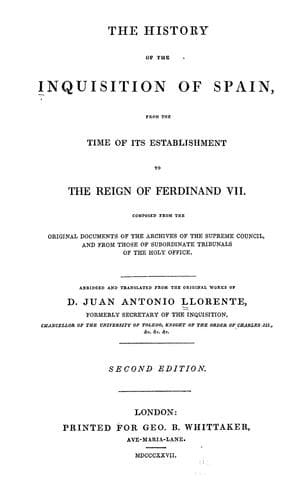
The History of the Inquisition of Spain from the Time of its Establishment to the Reign of Ferdinand VII.Llorente, Juan Antonio
History
The History of the Inquisition of Spain from the Time of its Establishment to the Reign of Ferdinand VII.
Llorente, Juan Antonio
Inquisition -- Spain
I am of opinion, that the first Spaniards who followed the doctrines of
Luther were Franciscan monks; for Clement VII., in 1526, authorized the
general and provincials of the order of Minor Friars of St. Francis
d'Assiz, to absolve those of the community who had fallen into that
heresy, after they had taken an oath to renounce it for ever. Several
monks of the same order had already represented to the Pope, that by the
privileges granted to them in the bull _mare magnum_, and confirmed by
other decrees of the holy see, no stranger had a right to interfere in
their affairs, and that they did not recognize any judge but the judge
of their institution, even in cases of apostasy.
Manrique, embarrassed in his ministry by the pretensions of the
Franciscans, wrote to the Pope, who expedited, in 1525, a brief, by
which the inquisitor-general was empowered to take cognizance of these
affairs, assisted by a monk named by the prelate of the order, and that,
in cases of appeal from judgment, the Pope should be applied to: but
these appeals were afterwards ordered to be made before the
inquisitor-general.
_Trials of Several Persons._
During the ministry of the inquisitor-general Manrique, history points
out several illustrious and innocent victims of the tribunal, who were
suspected of Lutheranism: such was the venerable Juan d'Avila, who would
have been beatified, if he had been a monk, but he was only a secular
priest: he was called, in Spain, the _Apostle of Andalusia_, on account
of his exemplary life and his charitable actions. St. Theresa de Jesus
informs us, in her works, that she derived much assistance from his
counsels and doctrine. He preached the gospel with simplicity, and never
introduced into his discourses those questions which at that time so
disgracefully agitated the scholastic theologians. Some envious monks,
irritated at his aversion for disputes, united to plan his ruin. They
denounced some of his propositions to the Inquisition, as tending to
Lutheranism and the doctrines of the _illuminati_. In 1534, Juan d'Avila
was confined in the secret prison of the holy office, by an order of the
inquisitors; they did not make their resolution known to the Supreme
Council or to the ordinary, on the pretence that this measure was only
ordained in case of a difference of opinion. Although this proceeding
was contrary to the laws of the Inquisition, to the royal ordinances,
and those of the Supreme Council, yet they contemned these violations,
and even tacitly approved them, as no reprimand was addressed to the
offenders. This act of the Inquisition, which took place at Seville,
much affected the inquisitor-general: he occupied the see of that city,
and had the greatest esteem for Juan d'Avila, whom he regarded as a
saint, which was a fortunate circumstance for him, as the protection of
Manrique, as chief of the Inquisition, greatly contributed to prove his
innocence; d'Avila was acquitted, and continued to preach with the same
Public-domain text, read in full here on John Shaqi.
Reviews
Reviews
No reviews yet
Be the first to share your thoughts on this work.
Elsewhere in the archive
Join the Discussion
Join the discussion
Sign in to leave a comment or review.
Sign InorCreate an account