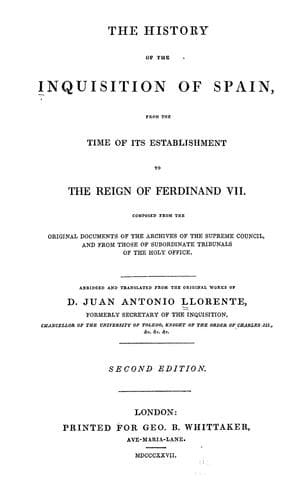
The History of the Inquisition of Spain from the Time of its Establishment to the Reign of Ferdinand VII.Llorente, Juan Antonio
History
The History of the Inquisition of Spain from the Time of its Establishment to the Reign of Ferdinand VII.
Llorente, Juan Antonio
Inquisition -- Spain
zeal and charity until his death.
This year was more fatal to two men, who are celebrated in the literary
history of Spain--Juan de Vergara, and Bernardin de Tobar, his brother:
they were arrested by the Inquisition of Toledo, and were not released
from its dungeons, until they had been subjected to the abjuration (_de
levi_) of the Lutheran heresy, to receive the absolution of censures _ad
cautelam_, and to several penances. Juan de Vergara was a canon of
Toledo, and had been secretary to Cardinal Ximenez de Cisneros, and to
Don Alphonso de Fonseca, his successor in the see of that city. Nicholas
Antonio has inserted, in his library, a notice of the literary
productions of this Spaniard, and does justice to his virtue and merit.
His profound knowledge of the Greek and Hebrew languages was the cause
of his misfortune; he had remarked some faults in the translation of the
Vulgate, and thus gave the signal for persecution to some monks who had
only studied Latin and the jargon of the schools. The chapter of Toledo
honoured his memory in placing on his tomb an epitaph, which is
preserved by the author I have cited. Vergara had a claim on the
gratitude of this community, for having composed the inscriptions which
decorate the choir of their church.
Bernardin de Tobar is less known, but Peter Martyr d'Angleria mentions
him among the learned men of the sixteenth century, and John Louis
Vives, a learned man of that age, says, in writing to Erasmus: "We live
in a difficult time; it is dangerous either to speak or be silent;
Vergara, his brother Bernardin de Tobar, and several other learned men,
have been arrested in Spain[7]."
Among this number was one of whom Vives could not give a particular
account. I speak of Alphonso Virues, a Benedictine, born at Olmedo, and
one of the best theologians of his time. He had a profound knowledge of
the oriental languages, and had composed several works. He was a member
of the commission which judged the works of Erasmus in 1527, and
preacher to Charles V., who listened to his discourses with so much
pleasure that he took him to Germany, and on his return to Spain would
not hear any other person. These distinctions excited the envy of the
monks, and they would have succeeded in their endeavours to ruin him,
but for the firmness and constancy of the emperor in protecting him.
Public-domain text, read in full here on John Shaqi.
Reviews
Reviews
No reviews yet
Be the first to share your thoughts on this work.
Elsewhere in the archive
Join the Discussion
Join the discussion
Sign in to leave a comment or review.
Sign InorCreate an account