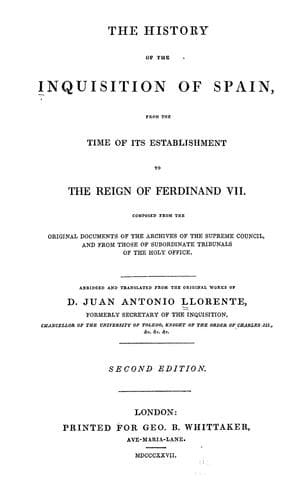
The History of the Inquisition of Spain from the Time of its Establishment to the Reign of Ferdinand VII.Llorente, Juan Antonio
History
The History of the Inquisition of Spain from the Time of its Establishment to the Reign of Ferdinand VII.
Llorente, Juan Antonio
Inquisition -- Spain
It is surprising that the affair of Virues, and many others, did not
make Charles V. perceive the nature of the Inquisition, and that he
still continued to protect that institution. However, the trial of his
preacher, and several other crosses which he experienced about that
time, were the reasons why he deprived the holy office of the royal
jurisdiction in 1535, and it was not restored until the year 1545. This
favour for Virues was so constant, that he soon after presented him to
the Pope for the bishopric of the Canaries; but the Pope refused him,
alleging that the suspicions raised against the purity of his faith
rendered him improper to be invested with the dignity of a bishop,
although the bull had declared him to be eligible. The emperor insisted,
and the Pope at length yielded to his pressing solicitations. Virues was
made Bishop of the Canaries in 1540.
In 1527 the Inquisition of Valladolid was occupied by an affair, of
which it is necessary to give an account, that the compassion and
indulgence which the inquisitors always professed in their acts, and
other forms of justice, may be justly appreciated.
One Diego Vallejo, of the village of Palacios de Meneses, in the diocese
of Palencia, having been arrested for blasphemy by the Inquisition,
declared, among other things, that two months before, on the 24th of
April, 1526, two physicians, named Alphonso Garcia and Juan de Salas,
were disputing on the subject of medicine, before him and Ferdinand
Ramirez, his son-in-law: the first maintained his opinion on the
authority of certain writers; Salas affirmed that these writers were
deceived; Garcia replied that his opinion was proved by the text of the
evangelists, which caused Salas to say _that they had lied as well as
the others_. Ferdinand Ramirez (who had also been arrested upon
suspicion of Judaism) was examined the same day; his deposition was the
same as that of Vallejo, but he added, that Salas returned to his house
some hours after, and in speaking of what had passed, said, "_What folly
I have asserted!_" When the tribunal had finished the affair of Ramirez
and Vallejo, they arrested Juan de Salas.
Public-domain text, read in full here on John Shaqi.
Reviews
Reviews
No reviews yet
Be the first to share your thoughts on this work.
Elsewhere in the archive
Join the Discussion
Join the discussion
Sign in to leave a comment or review.
Sign InorCreate an account