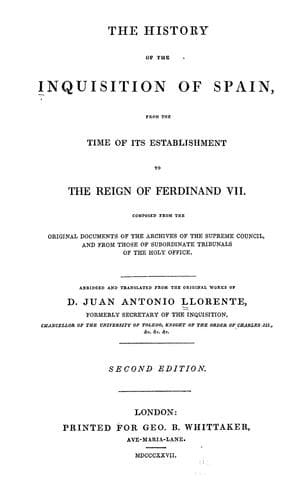
The History of the Inquisition of Spain from the Time of its Establishment to the Reign of Ferdinand VII.Llorente, Juan Antonio
History
The History of the Inquisition of Spain from the Time of its Establishment to the Reign of Ferdinand VII.
Llorente, Juan Antonio
Inquisition -- Spain
Virues was suspected of being favourable to the opinions of Luther, and
thrown into the secret prisons of the holy office at Seville. The
emperor, who knew him well, both from his sermons, and the intercourse
which took place during their travels in Germany, felt this blow
acutely, and not doubting that Virues was the victim of an intrigue
which the inquisitor-general ought to have prevented, he exiled
Manrique, who was obliged to retire to his archbishopric of Seville,
where he died in 1538. Not content with this, Charles commanded the
Supreme Council to address an ordinance to all the tribunals of the
Inquisition, importing, that in case of a preliminary instruction
sufficiently serious to cause the arrest of a monk, the decree of
imprisonment should be delayed, and that the inquisitors should send an
entire and faithful copy of the commencement of the proceedings to the
Supreme Council, and wait for the orders which would be sent them after
the examination of the writings.
The unfortunate Virues, nevertheless, suffered all the horrors of a
secret imprisonment for four years. During this period, as he writes to
Charles V., "he was scarcely allowed to breathe, or to occupy himself
with anything but charges, replies, testimonies, defences, libels,
means, acts (_nomina quæ et ipso poene timendo sono ... words which
cannot be heard without terrors_), or with heresies, blasphemies,
errors, anathemas, schisms, and other monsters, which, with labour that
may be compared to those of Hercules, I have at last conquered with the
aid of Jesus Christ, so that I am now justified through your majesty's
protection[8]."
One of the means employed by Virues for his defence, was to demand that
the tribunal should pay attention to the points of doctrine which he had
established, and prepared to attack Melancthon and other Lutherans
before the diet of Ratisbon; but this demand did not gain the object
which he had in view, which was a complete absolution, because his
enemies had denounced propositions advanced in public. Although he
proved that they were extremely Catholic, when examined with the text,
yet he could not prevent them from incurring the theological censure in
the form given by the denunciation: he was obliged to submit to an
abjuration of all heresies, particularly that of Luther and his
adherents. The definitive sentence was pronounced in 1537: he was
declared to be suspected of professing the errors of Luther, and
condemned to be absolved from the censures _ad cautelam_; to be confined
in a monastery for two years, and prohibited from preaching the word of
God for two years after his release.
The emperor, when informed of these transactions, complained to the
Pope, who, in 1538, addressed a brief to Virues, which contained a
dispensation from the different penances to which he had been condemned:
it also re-instated him in his office of preacher; and declared, that
what had passed could not exclude him from any office, not even from
episcopacy.
Public-domain text, read in full here on John Shaqi.
Reviews
Reviews
No reviews yet
Be the first to share your thoughts on this work.
Elsewhere in the archive
Join the Discussion
Join the discussion
Sign in to leave a comment or review.
Sign InorCreate an account