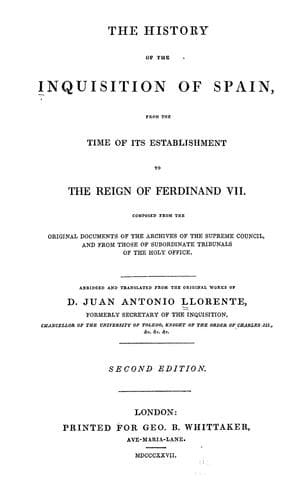
The History of the Inquisition of Spain from the Time of its Establishment to the Reign of Ferdinand VII.Llorente, Juan Antonio
History
The History of the Inquisition of Spain from the Time of its Establishment to the Reign of Ferdinand VII.
Llorente, Juan Antonio
Inquisition -- Spain
Raymond Gonzales de Montes (who, in 1558, was so fortunate as to escape
from the prisons of the holy office at Seville) wrote a book in Latin,
on the Inquisition, under the name of _Reginaldus Gonsalvius
Montanus_[9]. He informs us that the cord was wound eight or ten times
round the legs. Eleven turns were made round the limbs of Salas, besides
those of the _garot_. We may form an idea of the humanity of the
Inquisition of Valladolid, from the definitive sentence pronounced by
the licentiate Moriz and his colleague, Doctor Alvarado, without any
other formality, after they had taken (if we may believe them) the
advice of persons noted for their learning and virtue, but without the
adjournment which ought to have preceded it, and without the concurrence
of the diocesan in ordinary. They declared that the fiscal had not
entirely proved the accusation, and that the prisoner had succeeded in
destroying some of the charges; but that on account of the suspicion
arising from the trial, Juan de Salas was condemned to the punishment of
the public _auto-da-fé_, in his shirt, without a cloak, his head
uncovered, and with a torch in his hand; that he should abjure heresy
publicly, and that he should pay ten ducats of gold to the Inquisition,
and fulfil his penance in the church assigned. It is seen, by a
certificate afterwards given in, that Juan de Salas performed his
_auto-da-fé_ on the 24th of June, 1528, and that his father paid the
fine: the trial offers no other peculiarity. This affair, and several
others of a similar nature, caused the Supreme Council to publish a
decree in 1558, commanding that the torture should not be administered
without an order from the council.
_Letter-Orders, relating to the Proceedings._
The abuse of the secrecy of the proceedings caused a number of
complaints to be addressed to the inquisitor-general. He usually
referred them to the Supreme Council, which, during the administration
of Manrique, addressed several circulars to the provincial tribunals: it
is necessary to make known the most important.
In one of these writings, dated March 14th, 1528, it is said, that if an
accused person (when asked a general question) declares at first that he
knows nothing on the subject, and afterwards, when questioned on a
particular fact, confesses that he is acquainted with it (in case the
inquisitors think proper to take down the second declaration, to make
use of it against a third), they should insert the first question and
the answer of the accused in the same verbal process, because it might
assist in determining the degree of confidence to be placed in his
declarations.
Public-domain text, read in full here on John Shaqi.
Reviews
Reviews
No reviews yet
Be the first to share your thoughts on this work.
Elsewhere in the archive
Join the Discussion
Join the discussion
Sign in to leave a comment or review.
Sign InorCreate an account