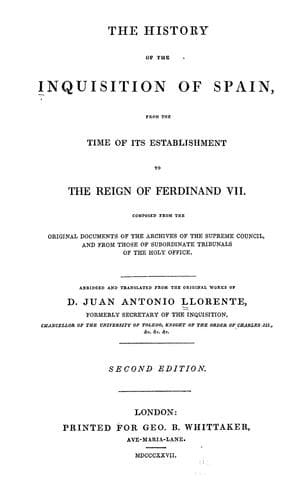
The History of the Inquisition of Spain from the Time of its Establishment to the Reign of Ferdinand VII.Llorente, Juan Antonio
History
The History of the Inquisition of Spain from the Time of its Establishment to the Reign of Ferdinand VII.
Llorente, Juan Antonio
Inquisition -- Spain
On the 16th of March, 1530, another instruction of the council appeared.
It directed that the facts related by the witnesses in favour of the
prisoner should be mentioned as well as those against him. This
direction, however just, has not been strictly followed, since it was
never observed in the extract of the publication of the depositions
given to the accused and his defender; consequently, no advantage could
be derived by the prisoner from the declarations in his favour.
Another circular of the 13th of May in the same year, says, that if an
accused person challenges a witness, he must be interrogated on the
foundation of the proceedings, as he might have facts to depose against
the accused.
On the 16th June, 1531, the council wrote to the tribunals, that if the
accused challenged several persons, on the supposition that they will
depose against him, the witnesses whom he calls to prove the facts which
caused the challenge, shall be examined on each individual, although
they have not made any deposition, in order that the accused may not
suppose at the time of the publication of the depositions, from an
omission (if there should be any), that some have deposed against him,
and that the others are not mentioned, or have not said anything.
Another instruction on the 13th of May, 1532, directs, that the
relations of the accused shall not be admitted as witnesses in the proof
of the challenge.
In another decree of the 5th March, 1535, it is ordained that the
witness shall be asked if there is any enmity between them and the
accused.
On the 20th of July, the council obliged the tribunals to insert in the
extract of the publication of the depositions, the day, the month, and
the hour when each witness gave his evidence.
In March, 1525, it was decreed, that when the extract was given to the
accused, he was not to be informed that any witness had declared the
fact to be known to others, because if they said nothing against him, it
was not proper to inform the accused of it, as he would learn, from that
circumstance, that some persons had spoken in his favour, or at least
had declared that they knew nothing against him.
Another regulation of the 8th of April, 1533, prohibited the inquisitors
from communicating the extract of the publication of the depositions to
the accused, before the ratification of the declarations.
The council decreed, on the 22d December, 1536, that in transacting any
business relating to circumstances which took place in the house of a
person deceased, so that the corpse was still exposed to view, and that
its position, figure, or other circumstance, might tend to discover if
he died a heretic or not, the name of the defunct, his house, and other
details, should be communicated to the witnesses, that they might be
enabled to recollect the event, and to assist them in making their
declaration.
Public-domain text, read in full here on John Shaqi.
Reviews
Reviews
No reviews yet
Be the first to share your thoughts on this work.
Elsewhere in the archive
Join the Discussion
Join the discussion
Sign in to leave a comment or review.
Sign InorCreate an account