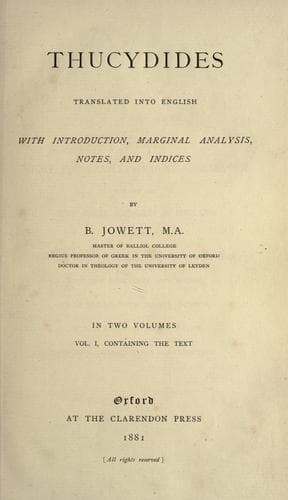
Greece -- History -- Peloponnesian War, 431-404 B.C.
The next summer the Peloponnesians and their allies, instead of
invading Attica, marched against Plataea, under the command of
Archidamus, son of Zeuxidamus, king of the Lacedaemonians. He had
encamped his army and was about to lay waste the country, when the
Plataeans hastened to send envoys to him, and spoke as follows:
“Archidamus and Lacedaemonians, in invading the Plataean territory, you
do what is wrong in itself, and worthy neither of yourselves nor of the
fathers who begot you. Pausanias, son of Cleombrotus, your countryman,
after freeing Hellas from the Medes with the help of those Hellenes who
were willing to undertake the risk of the battle fought near our city,
offered sacrifice to Zeus the Liberator in the marketplace of Plataea,
and calling all the allies together restored to the Plataeans their
city and territory, and declared it independent and inviolate against
aggression or conquest. Should any such be attempted, the allies
present were to help according to their power. Your fathers rewarded us
thus for the courage and patriotism that we displayed at that perilous
epoch; but you do just the contrary, coming with our bitterest enemies,
the Thebans, to enslave us. We appeal, therefore, to the gods to whom
the oaths were then made, to the gods of your ancestors, and lastly to
those of our country, and call upon you to refrain from violating our
territory or transgressing the oaths, and to let us live independent,
as Pausanias decreed.”
The Plataeans had got thus far when they were cut short by Archidamus
saying: “There is justice, Plataeans, in what you say, if you act up to
your words. According, to the grant of Pausanias, continue to be
independent yourselves, and join in freeing those of your fellow
countrymen who, after sharing in the perils of that period, joined in
the oaths to you, and are now subject to the Athenians; for it is to
free them and the rest that all this provision and war has been made. I
could wish that you would share our labours and abide by the oaths
yourselves; if this is impossible, do what we have already required of
you—remain neutral, enjoying your own; join neither side, but receive
both as friends, neither as allies for the war. With this we shall be
satisfied.” Such were the words of Archidamus. The Plataeans, after
hearing what he had to say, went into the city and acquainted the
people with what had passed, and presently returned for answer that it
was impossible for them to do what he proposed without consulting the
Athenians, with whom their children and wives now were; besides which
they had their fears for the town. After his departure, what was to
prevent the Athenians from coming and taking it out of their hands, or
the Thebans, who would be included in the oaths, from taking advantage
of the proposed neutrality to make a second attempt to seize the city?
Upon these points he tried to reassure them by saying: “You have only
Public-domain text, read in full here on John Shaqi.
Reviews
Reviews
No reviews yet
Be the first to share your thoughts on this work.
Elsewhere in the archive
Join the Discussion
Join the discussion
Sign in to leave a comment or review.
Sign InorCreate an account