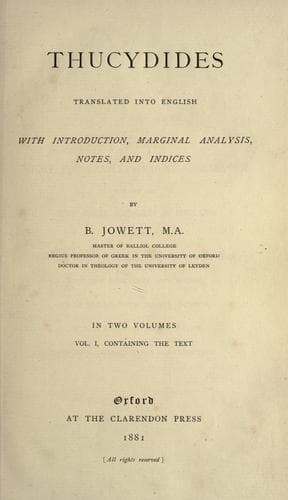
Greece -- History -- Peloponnesian War, 431-404 B.C.
With reference to the speeches in this history, some were delivered
before the war began, others while it was going on; some I heard
myself, others I got from various quarters; it was in all cases
difficult to carry them word for word in one’s memory, so my habit has
been to make the speakers say what was in my opinion demanded of them
by the various occasions, of course adhering as closely as possible to
the general sense of what they really said. And with reference to the
narrative of events, far from permitting myself to derive it from the
first source that came to hand, I did not even trust my own
impressions, but it rests partly on what I saw myself, partly on what
others saw for me, the accuracy of the report being always tried by the
most severe and detailed tests possible. My conclusions have cost me
some labour from the want of coincidence between accounts of the same
occurrences by different eye-witnesses, arising sometimes from
imperfect memory, sometimes from undue partiality for one side or the
other. The absence of romance in my history will, I fear, detract
somewhat from its interest; but if it be judged useful by those
inquirers who desire an exact knowledge of the past as an aid to the
interpretation of the future, which in the course of human things must
resemble if it does not reflect it, I shall be content. In fine, I have
written my work, not as an essay which is to win the applause of the
moment, but as a possession for all time.
The Median War, the greatest achievement of past times, yet found a
speedy decision in two actions by sea and two by land. The
Peloponnesian War was prolonged to an immense length, and, long as it
was, it was short without parallel for the misfortunes that it brought
upon Hellas. Never had so many cities been taken and laid desolate,
here by the barbarians, here by the parties contending (the old
inhabitants being sometimes removed to make room for others); never was
there so much banishing and blood-shedding, now on the field of battle,
now in the strife of faction. Old stories of occurrences handed down by
tradition, but scantily confirmed by experience, suddenly ceased to be
incredible; there were earthquakes of unparalleled extent and violence;
eclipses of the sun occurred with a frequency unrecorded in previous
history; there were great droughts in sundry places and consequent
famines, and that most calamitous and awfully fatal visitation, the
plague. All this came upon them with the late war, which was begun by
the Athenians and Peloponnesians by the dissolution of the thirty
years’ truce made after the conquest of Euboea. To the question why
they broke the treaty, I answer by placing first an account of their
grounds of complaint and points of difference, that no one may ever
have to ask the immediate cause which plunged the Hellenes into a war
of such magnitude. The real cause I consider to be the one which was
formally most kept out of sight. The growth of the power of Athens, and
Public-domain text, read in full here on John Shaqi.
Reviews
Reviews
No reviews yet
Be the first to share your thoughts on this work.
Join the Discussion
Join the discussion
Sign in to leave a comment or review.
Sign InorCreate an account