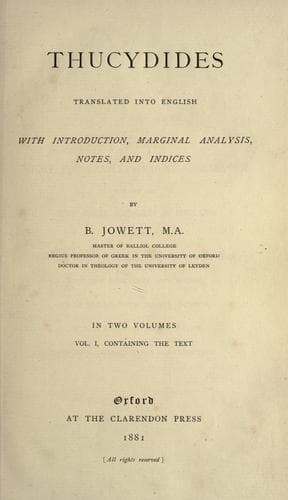
Greece -- History -- Peloponnesian War, 431-404 B.C.
Discovering this the Peloponnesians twisted up clay in wattles of reed
and threw it into the breach formed in the mound, in order to give it
consistency and prevent its being carried away like the soil. Stopped
in this way the Plataeans changed their mode of operation, and digging
a mine from the town calculated their way under the mound, and began to
carry off its material as before. This went on for a long while without
the enemy outside finding it out, so that for all they threw on the top
their mound made no progress in proportion, being carried away from
beneath and constantly settling down in the vacuum. But the Plataeans,
fearing that even thus they might not be able to hold out against the
superior numbers of the enemy, had yet another invention. They stopped
working at the large building in front of the mound, and starting at
either end of it inside from the old low wall, built a new one in the
form of a crescent running in towards the town; in order that in the
event of the great wall being taken this might remain, and the enemy
have to throw up a fresh mound against it, and as they advanced within
might not only have their trouble over again, but also be exposed to
missiles on their flanks. While raising the mound the Peloponnesians
also brought up engines against the city, one of which was brought up
upon the mound against the great building and shook down a good piece
of it, to the no small alarm of the Plataeans. Others were advanced
against different parts of the wall but were lassoed and broken by the
Plataeans; who also hung up great beams by long iron chains from either
extremity of two poles laid on the wall and projecting over it, and
drew them up at an angle whenever any point was threatened by the
engine, and loosing their hold let the beam go with its chains slack,
so that it fell with a run and snapped off the nose of the battering
ram.
Public-domain text, read in full here on John Shaqi.
Reviews
Reviews
No reviews yet
Be the first to share your thoughts on this work.
Elsewhere in the archive
Join the Discussion
Join the discussion
Sign in to leave a comment or review.
Sign InorCreate an account