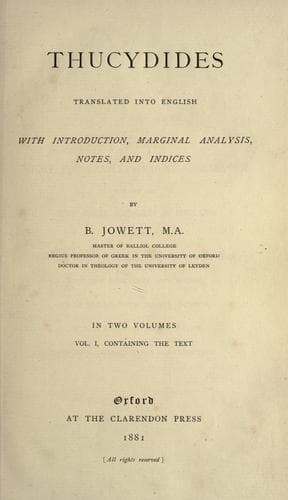
Greece -- History -- Peloponnesian War, 431-404 B.C.
After this the Peloponnesians, finding that their engines effected
nothing, and that their mound was met by the counterwork, concluded
that their present means of offence were unequal to the taking of the
city, and prepared for its circumvallation. First, however, they
determined to try the effects of fire and see whether they could not,
with the help of a wind, burn the town, as it was not a large one;
indeed they thought of every possible expedient by which the place
might be reduced without the expense of a blockade. They accordingly
brought faggots of brushwood and threw them from the mound, first into
the space between it and the wall; and this soon becoming full from the
number of hands at work, they next heaped the faggots up as far into
the town as they could reach from the top, and then lighted the wood by
setting fire to it with sulphur and pitch. The consequence was a fire
greater than any one had ever yet seen produced by human agency, though
it could not of course be compared to the spontaneous conflagrations
sometimes known to occur through the wind rubbing the branches of a
mountain forest together. And this fire was not only remarkable for its
magnitude, but was also, at the end of so many perils, within an ace of
proving fatal to the Plataeans; a great part of the town became
entirely inaccessible, and had a wind blown upon it, in accordance with
the hopes of the enemy, nothing could have saved them. As it was, there
is also a story of heavy rain and thunder having come on by which the
fire was put out and the danger averted.
Failing in this last attempt the Peloponnesians left a portion of their
forces on the spot, dismissing the rest, and built a wall of
circumvallation round the town, dividing the ground among the various
cities present; a ditch being made within and without the lines, from
which they got their bricks. All being finished by about the rising of
Arcturus, they left men enough to man half the wall, the rest being
manned by the Boeotians, and drawing off their army dispersed to their
several cities. The Plataeans had before sent off their wives and
children and oldest men and the mass of the non-combatants to Athens;
so that the number of the besieged left in the place comprised four
hundred of their own citizens, eighty Athenians, and a hundred and ten
women to bake their bread. This was the sum total at the commencement
of the siege, and there was no one else within the walls, bond or free.
Such were the arrangements made for the blockade of Plataea.
Public-domain text, read in full here on John Shaqi.
Reviews
Reviews
No reviews yet
Be the first to share your thoughts on this work.
Elsewhere in the archive
Join the Discussion
Join the discussion
Sign in to leave a comment or review.
Sign InorCreate an account