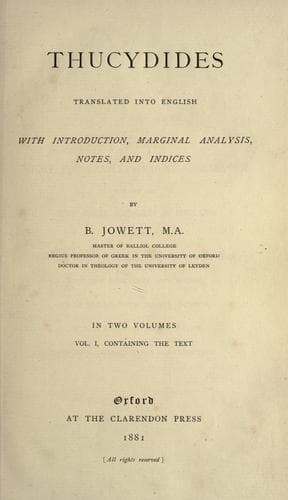
Greece -- History -- Peloponnesian War, 431-404 B.C.
The Corcyraean revolution began with the return of the prisoners taken
in the sea-fights off Epidamnus. These the Corinthians had released,
nominally upon the security of eight hundred talents given by their
proxeni, but in reality upon their engagement to bring over Corcyra to
Corinth. These men proceeded to canvass each of the citizens, and to
intrigue with the view of detaching the city from Athens. Upon the
arrival of an Athenian and a Corinthian vessel, with envoys on board, a
conference was held in which the Corcyraeans voted to remain allies of
the Athenians according to their agreement, but to be friends of the
Peloponnesians as they had been formerly. Meanwhile, the returned
prisoners brought Peithias, a volunteer proxenus of the Athenians and
leader of the commons, to trial, upon the charge of enslaving Corcyra
to Athens. He, being acquitted, retorted by accusing five of the
richest of their number of cutting stakes in the ground sacred to Zeus
and Alcinous; the legal penalty being a stater for each stake. Upon
their conviction, the amount of the penalty being very large, they
seated themselves as suppliants in the temples to be allowed to pay it
by instalments; but Peithias, who was one of the senate, prevailed upon
that body to enforce the law; upon which the accused, rendered
desperate by the law, and also learning that Peithias had the
intention, while still a member of the senate, to persuade the people
to conclude a defensive and offensive alliance with Athens, banded
together armed with daggers, and suddenly bursting into the senate
killed Peithias and sixty others, senators and private persons; some
few only of the party of Peithias taking refuge in the Athenian galley,
which had not yet departed.
After this outrage, the conspirators summoned the Corcyraeans to an
assembly, and said that this would turn out for the best, and would
save them from being enslaved by Athens: for the future, they moved to
receive neither party unless they came peacefully in a single ship,
treating any larger number as enemies. This motion made, they compelled
it to be adopted, and instantly sent off envoys to Athens to justify
what had been done and to dissuade the refugees there from any hostile
proceedings which might lead to a reaction.
Upon the arrival of the embassy, the Athenians arrested the envoys and
all who listened to them, as revolutionists, and lodged them in Aegina.
Meanwhile a Corinthian galley arriving in the island with Lacedaemonian
envoys, the dominant Corcyraean party attacked the commons and defeated
them in battle. Night coming on, the commons took refuge in the
Acropolis and the higher parts of the city, and concentrated themselves
there, having also possession of the Hyllaic harbour; their adversaries
occupying the market-place, where most of them lived, and the harbour
adjoining, looking towards the mainland.
Public-domain text, read in full here on John Shaqi.
Reviews
Reviews
No reviews yet
Be the first to share your thoughts on this work.
Elsewhere in the archive
Join the Discussion
Join the discussion
Sign in to leave a comment or review.
Sign InorCreate an account