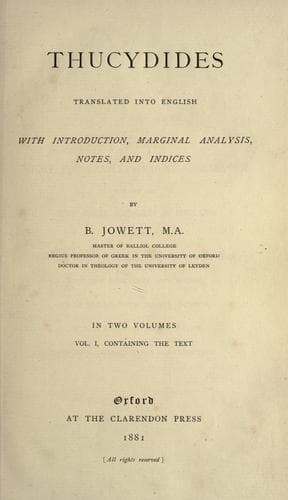
Greece -- History -- Peloponnesian War, 431-404 B.C.
Accordingly they now allowed the Athenians to ravage their seaboard,
without making any movement, the garrisons in whose neighbourhood the
descents were made always thinking their numbers insufficient, and
sharing the general feeling. A single garrison which ventured to
resist, near Cotyrta and Aphrodisia, struck terror by its charge into
the scattered mob of light troops, but retreated, upon being received
by the heavy infantry, with the loss of a few men and some arms, for
which the Athenians set up a trophy, and then sailed off to Cythera.
From thence they sailed round to Epidaurus Limera, ravaged part of the
country, and so came to Thyrea in the Cynurian territory, upon the
Argive and Laconian border. This district had been given by its
Lacedaemonian owners to the expelled Aeginetans to inhabit, in return
for their good offices at the time of the earthquake and the rising of
the Helots; and also because, although subjects of Athens, they had
always sided with Lacedaemon.
While the Athenians were still at sea, the Aeginetans evacuated a fort
which they were building upon the coast, and retreated into the upper
town where they lived, rather more than a mile from the sea. One of the
Lacedaemonian district garrisons which was helping them in the work,
refused to enter here with them at their entreaty, thinking it
dangerous to shut themselves up within the wall, and retiring to the
high ground remained quiet, not considering themselves a match for the
enemy. Meanwhile the Athenians landed, and instantly advanced with all
their forces and took Thyrea. The town they burnt, pillaging what was
in it; the Aeginetans who were not slain in action they took with them
to Athens, with Tantalus, son of Patrocles, their Lacedaemonian
commander, who had been wounded and taken prisoner. They also took with
them a few men from Cythera whom they thought it safest to remove.
These the Athenians determined to lodge in the islands: the rest of the
Cytherians were to retain their lands and pay four talents tribute; the
Aeginetans captured to be all put to death, on account of the old
inveterate feud; and Tantalus to share the imprisonment of the
Lacedaemonians taken on the island.
The same summer, the inhabitants of Camarina and Gela in Sicily first
made an armistice with each other, after which embassies from all the
other Sicilian cities assembled at Gela to try to bring about a
pacification. After many expressions of opinion on one side and the
other, according to the griefs and pretensions of the different parties
complaining, Hermocrates, son of Hermon, a Syracusan, the most
influential man among them, addressed the following words to the
assembly:
Public-domain text, read in full here on John Shaqi.
Reviews
Reviews
No reviews yet
Be the first to share your thoughts on this work.
Elsewhere in the archive
Join the Discussion
Join the discussion
Sign in to leave a comment or review.
Sign InorCreate an account