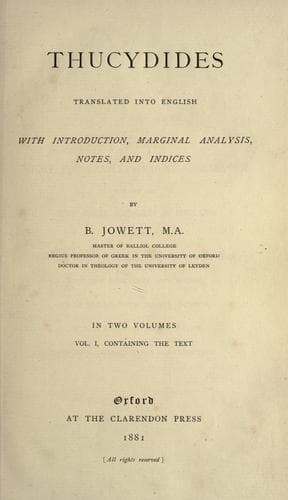
Greece -- History -- Peloponnesian War, 431-404 B.C.
After this Brasidas and the army came nearer to the sea and to Megara,
and taking up a convenient position, remained quiet in order of battle,
expecting to be attacked by the Athenians and knowing that the
Megarians were waiting to see which would be the victor. This attitude
seemed to present two advantages. Without taking the offensive or
willingly provoking the hazards of a battle, they openly showed their
readiness to fight, and thus without bearing the burden of the day
would fairly reap its honours; while at the same time they effectually
served their interests at Megara. For if they had failed to show
themselves they would not have had a chance, but would have certainly
been considered vanquished, and have lost the town. As it was, the
Athenians might possibly not be inclined to accept their challenge, and
their object would be attained without fighting. And so it turned out.
The Athenians formed outside the long walls and, the enemy not
attacking, there remained motionless; their generals having decided
that the risk was too unequal. In fact most of their objects had been
already attained; and they would have to begin a battle against
superior numbers, and if victorious could only gain Megara, while a
defeat would destroy the flower of their heavy soldiery. For the enemy
it was different; as even the states actually represented in his army
risked each only a part of its entire force, he might well be more
audacious. Accordingly, after waiting for some time without either side
attacking, the Athenians withdrew to Nisaea, and the Peloponnesians
after them to the point from which they had set out. The friends of the
Megarian exiles now threw aside their hesitation, and opened the gates
to Brasidas and the commanders from the different states—looking upon
him as the victor and upon the Athenians as having declined the
battle—and receiving them into the town proceeded to discuss matters
with them; the party in correspondence with the Athenians being
paralysed by the turn things had taken.
Public-domain text, read in full here on John Shaqi.
Reviews
Reviews
No reviews yet
Be the first to share your thoughts on this work.
Elsewhere in the archive
Join the Discussion
Join the discussion
Sign in to leave a comment or review.
Sign InorCreate an account