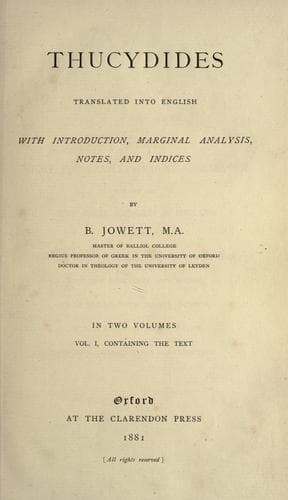
Greece -- History -- Peloponnesian War, 431-404 B.C.
The Boeotians set up a trophy, took up their own dead, and stripped
those of the enemy, and leaving a guard over them retired to Tanagra,
there to take measures for attacking Delium. Meanwhile a herald came
from the Athenians to ask for the dead, but was met and turned back by
a Boeotian herald, who told him that he would effect nothing until the
return of himself the Boeotian herald, and who then went on to the
Athenians, and told them on the part of the Boeotians that they had
done wrong in transgressing the law of the Hellenes. Of what use was
the universal custom protecting the temples in an invaded country, if
the Athenians were to fortify Delium and live there, acting exactly as
if they were on unconsecrated ground, and drawing and using for their
purposes the water which they, the Boeotians, never touched except for
sacred uses? Accordingly for the god as well as for themselves, in the
name of the deities concerned, and of Apollo, the Boeotians invited
them first to evacuate the temple, if they wished to take up the dead
that belonged to them.
After these words from the herald, the Athenians sent their own herald
to the Boeotians to say that they had not done any wrong to the temple,
and for the future would do it no more harm than they could help; not
having occupied it originally in any such design, but to defend
themselves from it against those who were really wronging them. The law
of the Hellenes was that conquest of a country, whether more or less
extensive, carried with it possession of the temples in that country,
with the obligation to keep up the usual ceremonies, at least as far as
possible. The Boeotians and most other people who had turned out the
owners of a country, and put themselves in their places by force, now
held as of right the temples which they originally entered as usurpers.
If the Athenians could have conquered more of Boeotia this would have
been the case with them: as things stood, the piece of it which they
had got they should treat as their own, and not quit unless obliged.
The water they had disturbed under the impulsion of a necessity which
they had not wantonly incurred, having been forced to use it in
defending themselves against the Boeotians who first invaded Attica.
Besides, anything done under the pressure of war and danger might
reasonably claim indulgence even in the eye of the god; or why, pray,
were the altars the asylum for involuntary offences? Transgression also
was a term applied to presumptuous offenders, not to the victims of
adverse circumstances. In short, which were most impious—the Boeotians
who wished to barter dead bodies for holy places, or the Athenians who
refused to give up holy places to obtain what was theirs by right? The
condition of evacuating Boeotia must therefore be withdrawn. They were
no longer in Boeotia. They stood where they stood by the right of the
sword. All that the Boeotians had to do was to tell them to take up
Public-domain text, read in full here on John Shaqi.
Reviews
Reviews
No reviews yet
Be the first to share your thoughts on this work.
Elsewhere in the archive
Join the Discussion
Join the discussion
Sign in to leave a comment or review.
Sign InorCreate an account