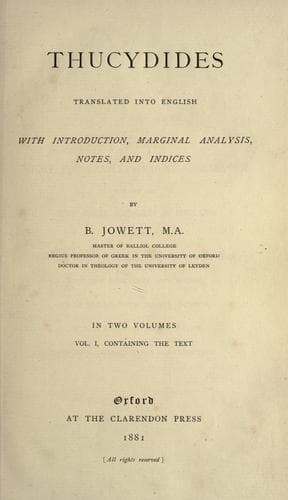
Greece -- History -- Peloponnesian War, 431-404 B.C.
While the Peloponnesians were still mustering at the Isthmus, or on the
march before they invaded Attica, Pericles, son of Xanthippus, one of
the ten generals of the Athenians, finding that the invasion was to
take place, conceived the idea that Archidamus, who happened to be his
friend, might possibly pass by his estate without ravaging it. This he
might do, either from a personal wish to oblige him, or acting under
instructions from Lacedaemon for the purpose of creating a prejudice
against him, as had been before attempted in the demand for the
expulsion of the accursed family. He accordingly took the precaution of
announcing to the Athenians in the assembly that, although Archidamus
was his friend, yet this friendship should not extend to the detriment
of the state, and that in case the enemy should make his houses and
lands an exception to the rest and not pillage them, he at once gave
them up to be public property, so that they should not bring him into
suspicion. He also gave the citizens some advice on their present
affairs in the same strain as before. They were to prepare for the war,
and to carry in their property from the country. They were not to go
out to battle, but to come into the city and guard it, and get ready
their fleet, in which their real strength lay. They were also to keep a
tight rein on their allies—the strength of Athens being derived from
the money brought in by their payments, and success in war depending
principally upon conduct and capital, had no reason to despond. Apart
from other sources of income, an average revenue of six hundred talents
of silver was drawn from the tribute of the allies; and there were
still six thousand talents of coined silver in the Acropolis, out of
nine thousand seven hundred that had once been there, from which the
money had been taken for the porch of the Acropolis, the other public
buildings, and for Potidæa. This did not include the uncoined gold and
silver in public and private offerings, the sacred vessels for the
processions and games, the Median spoils, and similar resources to the
amount of five hundred talents. To this he added the treasures of the
other temples. These were by no means inconsiderable, and might fairly
be used. Nay, if they were ever absolutely driven to it, they might
take even the gold ornaments of Athene herself; for the statue
contained forty talents of pure gold and it was all removable. This
might be used for self-preservation, and must every penny of it be
restored. Such was their financial position—surely a satisfactory one.
Then they had an army of thirteen thousand heavy infantry, besides
sixteen thousand more in the garrisons and on home duty at Athens. This
was at first the number of men on guard in the event of an invasion: it
was composed of the oldest and youngest levies and the resident aliens
who had heavy armour. The Phaleric wall ran for four miles, before it
joined that round the city; and of this last nearly five had a guard,
Public-domain text, read in full here on John Shaqi.
Reviews
Reviews
No reviews yet
Be the first to share your thoughts on this work.
Elsewhere in the archive
Join the Discussion
Join the discussion
Sign in to leave a comment or review.
Sign InorCreate an account