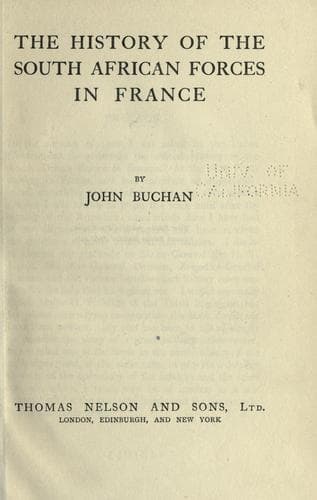
The history of the South African forces in FranceBuchan, John
History
The history of the South African forces in France
Buchan, John
South Africa. Army; World War, 1914-1918 -- Campaigns -- France; World War, 1914-1918 -- Regimental histories -- South Africa
Ludendorff’s plan was based upon the highly specialized training of
certain units, and was a legitimate conclusion from the German use of
“storm troops.” The first point was the absence of any preliminary
massing near the front of attack. Men were brought up by night marches
just before zero hour, and secrecy was thus obtained for the assembly.
Again, there was no long bombardment to alarm the enemy, and the guns
began at the moment when the infantry advanced, the enemy’s back areas
being confused by a deluge of gas shells. The assault was made by picked
troops in open order, or rather in small clusters, carrying light trench
mortars and many machine guns, with the field batteries close behind
them in support. The actual mode of attack, which the French called
“infiltration,” may be likened to a hand, of which the finger-tips are
shod with steel, and which is pushed into a soft substance. The picked
troops at the finger-ends made gaps through which others poured, till
each section of the defence found itself outflanked and encircled. A
system of flares and rockets enabled the following troops to learn where
the picked troops had made the breach, and the artillery came close
behind the infantry. The men had unlimited objectives, and carried iron
rations for several days. When one division had reached the end of
its strength, another took its place, so that the advance resembled a
continuous game of leap-frog.
This method was the opposite of the old German mass attack, which had
seen a succession of hammer-blows on one section of front. It was
strictly the filtering of a great army into a hostile position, so that
each part was turned, and the whole front was first dislocated and
then crumbled. This might be achieved by inferior numbers; but a local
numerical superiority was aimed at to ensure a complete victory by
pushing far behind into unprotected areas. Advance was to be measured
not by metres but by miles, and in any case was to proceed far enough
to capture the enemy’s artillery positions. Obviously the effect would
be cumulative, the momentum of the attack would grow, and, if it was
not stopped in the battle-zone, it would be far harder to stop in the
hinterland. It was no case of an isolated stroke, but of a creeping
sickness, which might demoralize a hundred miles of front. Ludendorff was
confident, for he saw his way presently to a numerical superiority in the
West, and he had devised tactics which must come with deadly effect upon
an enemy prepared to meet only the old methods. But his plan demanded
immediate success. A protracted battle would destroy the picked troops,
and without them the new tactics were futile.
Public-domain text, read in full here on John Shaqi.
Reviews
Reviews
No reviews yet
Be the first to share your thoughts on this work.
Elsewhere in the archive
Join the Discussion
Join the discussion
Sign in to leave a comment or review.
Sign InorCreate an account