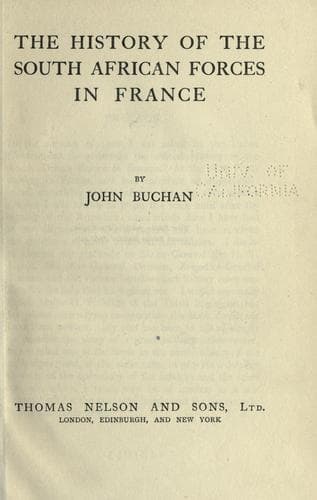
The history of the South African forces in FranceBuchan, John
History
The history of the South African forces in France
Buchan, John
South Africa. Army; World War, 1914-1918 -- Campaigns -- France; World War, 1914-1918 -- Regimental histories -- South Africa
The first experiment was made early in September, when von Hutier
captured Riga. But the true test came in October, when Otto von Below,
with the VI. German Army, broke through the Italian front at Caporetto,
and drove Cadorna behind the Piave. After that there could be no question
of the value of Germany’s plan. One other test, and her certainty
was complete. On 20th November Byng struck at Cambrai, achieving by
means of his tanks a genuine surprise. Ten days later came the German
counterstroke—in two parts. The attack on the British left at Bourlon,
carried out in the old fashion, signally failed. The attack on the
British right between Masnières and Vendhuile, following the new fashion,
as signally succeeded. But the Allied Staffs had not yet grasped the
full meaning of the new method. Caporetto was explained by a breakdown
in Italian _moral_ and Cambrai by defective local intelligence. Neither
explanation was sound, and four months later the armies of France and
Britain read the true lesson in letters of fire.
* * * * *
[Sidenote: _Nov. 20._]
On 20th November the 9th Division moved from the Belgian coast. The
South African Brigade spent some days in rest-billets in the Fruges
area, engaged in training the recruits which had arrived to replace the
casualties of Third Ypres. On the 30th news came of the counterstroke at
Cambrai, and the battalions were ordered to be ready to move at short
notice. On the morning of 1st December they began their long march
southward to the accompaniment of a deluge of rain and a sharp east wind.
The lorries which carried the kits and blankets did not turn up, being
required for some other purpose by the army controlling that area, with
the result that the men passed three nights of bitter weather without
adequate covering. Presently came snow, and then a binding frost, and
when, on 3rd December, the Brigade arrived at Moislains, it was after
three days of weary marches in the worst of weathers and a freezing night
in the train.
[Sidenote: _Dec. 3._]
Public-domain text, read in full here on John Shaqi.
Reviews
Reviews
No reviews yet
Be the first to share your thoughts on this work.
Elsewhere in the archive
Join the Discussion
Join the discussion
Sign in to leave a comment or review.
Sign InorCreate an account