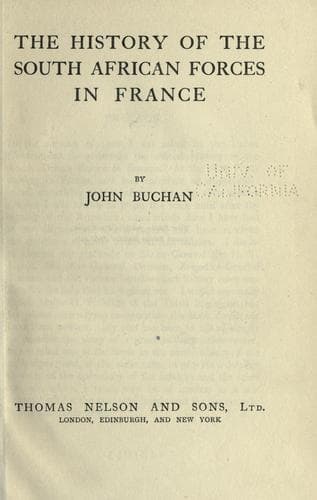
The history of the South African forces in FranceBuchan, John
History
The history of the South African forces in France
Buchan, John
South Africa. Army; World War, 1914-1918 -- Campaigns -- France; World War, 1914-1918 -- Regimental histories -- South Africa
The South African position was well placed for defence, for it had before
it a long, clear field of fire. But it was a trap from which there could
be no retreat, since all the land to the west was bare to the enemy’s
eyes. Dawson’s 500, on the morning of the 24th, had, each man, 200 rounds
of ammunition and a fair supply of Lewis gun drums. One section, however,
of the Machine Gun Battery had only four belts of ammunition, and three
of the guns with their teams were therefore sent back to the transport
lines at Savernake Wood.
Soon after daylight had struggled through the fog the enemy was seen
massing his troops on the ridge to the east, and about nine o’clock he
deployed for the attack, opening with machine-gun fire, and afterwards
with artillery. Dawson, divining what was coming, sent a messenger back
to the rear with the Brigade records. He had already been round every
part of the position, and had disposed his scanty forces to the best
advantage. At ten o’clock some British guns opened an accurate fire,
not upon the enemy, but upon the South African lines, especially on the
trench where was situated Brigade Headquarters. Dawson was compelled
to move to a neighbouring shell-hole. He sent a man on his last horse,
followed by two runners, to tell the batteries what was happening, but
the messengers do not seem to have reached their goal, and the fire
continued for more than an hour, though happily with few casualties.
After that it ceased, because the guns had retired. One of our heavies
continued to fire on Bouchavesnes, and presently that, too, was silent.
It was the last the Brigade heard of the British artillery.
Meantime the enemy gun-fire had become intense, and the whole position
was smothered in dust and fumes. Men could not keep their rifles clean
because of the débris choking the air. The Germans were now some 750
yards from our front, but did not attempt for the moment to approach
closer, fearing the accuracy of the South African marksmanship. The
firing was mostly done at this time by Lewis guns, for ammunition had to
be husbanded, and the men were ordered not to use their rifles till the
enemy was within 400 yards. He attempted to bring a field gun into action
at a range of 1,000 yards, but a Lewis gunner of the 1st Regiment knocked
out the team before the gun could be fired. A little later another
attempt was made, and a field gun was brought forward at a gallop. Once
again the fire of the same Lewis gunner proved its undoing. The team got
out of hand and men and horses went down in a struggling mass.
Public-domain text, read in full here on John Shaqi.
Reviews
Reviews
No reviews yet
Be the first to share your thoughts on this work.
Elsewhere in the archive
Join the Discussion
Join the discussion
Sign in to leave a comment or review.
Sign InorCreate an account